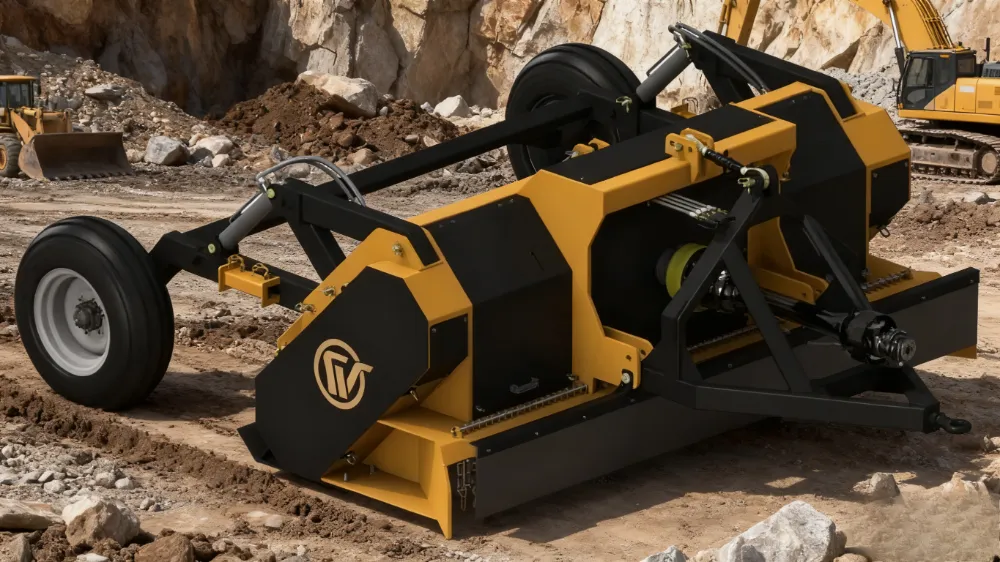
Stones in vineyard soils are one of the most persistent and costly management problems for European vine growers. They damage mechanical harvesters, wear out under-vine tillage equipment, reduce working speeds during cultivation, and in severe cases contribute to vine root damage when surface stones are large enough to deflect tillage tools into the root zone. A tractor stone crusher permanently eliminates this problem — but only if the machine is correctly specified for vineyard conditions.
Vineyard stone crusher selection is more constrained than open arable work. Row spacing, vine infrastructure, machine weight, and tractor size all impose limits that do not exist in a flat open field. This guide walks through every key specification decision for vine row stone clearing — and identifies the models best suited to European vineyard conditions.
Why standard crushers don’t fit
Working width requirements
Weight & compaction
PTO compatibility
Best models for vineyards
Operating tips
Domande frequenti
The Stone Problem in European Vineyards
European vineyard soils — particularly in the Netherlands, Belgium, Germany, and parts of France — frequently contain significant concentrations of surface and sub-surface stones. These stones originate from glacial deposition, post-agricultural tillage cycles, and in some regions from the natural character of the soil parent material. The result is a recurring stone burden that reappears after every deep cultivation cycle.
The consequences for vineyard operators are direct and measurable. Mechanical harvesters striking surface stones during picking suffer blade and picking finger damage that requires costly in-season repairs. Under-vine tillage machinery — rotary spaders, disc harrows, and inter-row cultivators — wears significantly faster in stony conditions, reducing service life and increasing annual maintenance costs. And during vine establishment, large surface stones can deflect planting tools away from their target depth, causing inconsistent planting that affects canopy development for the life of the vine.
Picking fingers and blades broken by surface stones cause in-season downtime at the most critical and time-sensitive point of the annual cycle.
Under-vine cultivation tools wear two to three times faster in stony conditions, increasing annual parts and labour costs for mechanical weed control operations.
Large surface stones deflect inter-row tillage tools into the vine root zone during cultivation, causing root damage that reduces vine health and longevity.
Why Standard Stone Crushers Don’t Fit in Vineyards
Most of the stone crusher range — including mid-range and heavy-duty models — are designed for open-field operation where working width, turning radius, and machine weight are not critically constrained. Vineyards impose three specific limits that immediately eliminate the majority of the range:
Standard European vine row spacing runs from approximately 1.2m in some traditional regions to 2.0m in mechanised production systems. The stone crusher’s total transport width must be narrow enough to drive between rows without contacting vine posts, wires, or foliage. A 2,300mm wide machine simply cannot enter a 1.5m row — regardless of its working performance in open field conditions.
Vineyard soils are typically cultivated to maintain low compaction — especially important in biodynamic and organic operations. Heavy mid-range and heavy-duty stone crushers (3,000–5,250kg) impose significant rear axle loads on the tractor, increasing tyre contact pressure and soil compaction risk in the vine inter-row. Light-duty models starting at 1,230kg are considerably better matched to this constraint.
Vineyard tractors are typically compact — from 70hp upward — with narrow front axles designed for inter-row work. The stone crusher must be compatible with the smaller tractors used in this environment, not the large 180–400hp machines used in open arable contracting. This limits the viable range to light-duty models rated from 70hp minimum.
The Critical Specification: Working Width
Working width is the most important specification for vineyard stone crusher selection. It must be narrow enough to fit within the vine row — but as wide as possible to maximise coverage per pass. The total machine width (transport width) is always wider than the working width and is the dimension that determines whether the machine can physically enter the row.
| MODEL | STCL/ST 100 | STCL/ST 125 | STCL/ST 150 | STCL/ST 175 |
|---|---|---|---|---|
| Dimensioni | ||||
| Larghezza di lavoro (mm) | 1,110 | 1,350 | 1,590 | 1,830 |
| Total width (mm) | 1,414 | 1,654 | 1,894 | 2,134 |
| Peso (kg) | 1,230 | 1,280 | 1,440 | 1,570 |
| Requisiti del trattore | ||||
| Engine power (hp) | 70–120 | 80–120 | 90–120 | 100–120 |
| Presa di forza (giri/min) | 540–1000 | 540–1000 | 540–1000 | 540–1000 |
| Vineyard Suitability | ||||
| Fits rows from (approx.) | 1.5m+ | 1.7m+ | 1.9m+ | Not recommended |
| Best for | Narrow traditional rows | Standard European rows | Wider mechanised rows | Open field only |
Allow a minimum clearance of 200mm on each side between the machine’s total width and the vine post spacing. If your rows are 1.8m post-to-post, the maximum total machine width is 1.4m — making the STCL/ST 100 (1,414mm total width) the safe choice. If posts are at 2.0m, the STCL/ST 125 (1,654mm total) fits with comfortable clearance. Measure your row spacing before ordering.
Machine Weight and Soil Compaction in Vineyards
Soil compaction in the vine inter-row is a significant concern for vine health and longevity. Compacted soils restrict root development, reduce water infiltration, and in severe cases limit the uptake of nutrients by the vine root system. Any implement used between the rows should have the lowest practical weight for its working width.
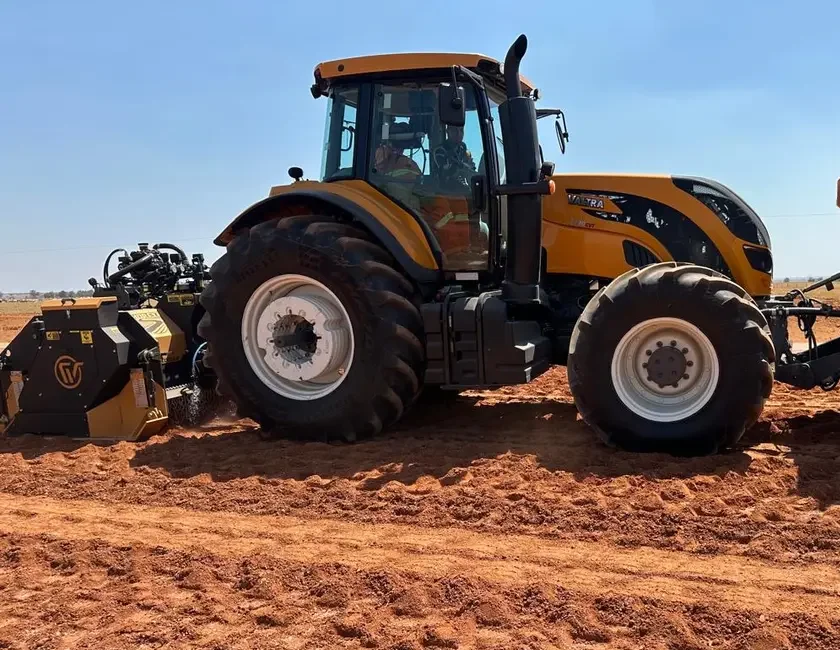
The STCL/ST 100 and ST 125 — at 1,230kg and 1,280kg respectively — are the lightest stone crusher configurations available. Mounted on the rear three-point linkage of a compact vineyard tractor, the total rear axle load is the sum of the machine weight plus the tractor’s rear axle static load. On most 70–90hp vineyard tractors with a rear axle capacity of 3,000–4,000kg, this combination is well within the rated limits.
To minimise compaction during stone crusher operation, work when soil moisture is at or below field capacity — never on waterlogged or saturated soils. Use the widest tractor tyres compatible with your row spacing to distribute the combined axle load across a larger footprint. A single pass of stone crusher work, done once on a newly established vineyard or after a major stone event, produces a permanent improvement that eliminates the need for repeated operations.
PTO Compatibility for Vineyard Tractors
Vineyard tractors span a wide age range — from modern purpose-built narrow-track machines to older European tractors that have been in vineyard service for 20 or 30 years. PTO compatibility is therefore a more variable consideration in viticulture than in arable farming, where most active tractors are relatively modern.
The STCL/ST series accepts both 540rpm and 1000rpm PTO inputs — the broadest compatibility in the range. This dual-speed acceptance makes these models compatible with virtually every vineyard tractor in European use, from pre-1990 machines with 540rpm-only PTO to modern tractors with switchable 540/1000rpm outputs. For guidance on identifying the right PTO shaft specification for your tractor and implement combination, see this PTO shaft selection guide.
Most older European vineyard tractors run 540rpm PTO only. The STCL/ST 100 and ST 125 accept 540rpm — compatible with all of these machines. Performance at 540rpm is fully adequate for the stone sizes (up to 150mm) and working depth (150mm) typical of vineyard conditions.
Modern vineyard tractors typically offer both 540rpm and 1000rpm PTO. Where 1000rpm is available, always use it — the higher rotor speed improves crushing efficiency and reduces the number of passes required to achieve a clean result. The STCL/ST series accepts both speeds without any modification.
Best Stone Crusher Configurations for European Vineyards
Based on the constraints above, two configurations stand out as the most appropriate for the majority of European vineyard operations:
The narrowest model in the range and the lowest machine weight — the correct choice for traditional narrow-row vineyards with post-to-post spacing from approximately 1.5m. Also the most compatible with older 70–80hp vineyard tractors running 540rpm PTO. The default recommendation for Dutch, Belgian, and German vine row clearance work.
The most popular vineyard and orchard model across Europe — the wider working width (1,350mm vs 1,110mm) improves daily output per tractor hour while still fitting within standard mechanised row spacings from approximately 1.7m post-to-post. From 80hp upward with 540 or 1000rpm PTO.
The STCL/ST 150 (1,894mm total width) and larger models should not be used in typical European vineyard inter-row conditions. Their total width exceeds the row spacing of most European vineyards, and their greater machine weight increases soil compaction risk significantly compared to the ST 100 and ST 125. If your row spacing is wide enough to accommodate the ST 150, confirm the total width clearance and tractor weight distribution before ordering.
Operating Tips for Vineyard Stone Crusher Work
Vineyard operation requires more care than open arable work. These practices protect vine infrastructure and improve results:
Never operate a stone crusher in vineyard inter-rows when the soil is wet or saturated. Wet conditions increase tyre sinkage, soil compaction, and the risk of rutting that damages vine root zones. Wait for the soil to reach below-field-capacity moisture content before starting work.
When approaching vine posts at the ends of rows, reduce rotor depth slightly to avoid the risk of the crusher housing contacting post anchor systems or sub-surface post bases. Most modern stone crushers allow depth adjustment via the rear roller setting — lower the machine before entering the headland zone.
In vineyard conditions, a forward speed of 1.0–2.0 km/h gives the best results — allowing the rotor to fully process stones before the machine moves past them. Higher speeds in tight conditions risk deflecting partially crushed material into vine posts or foliage. The slower pace also gives the operator more time to monitor machine clearance within the row.
The major advantage of a stone crusher over surface stone collection is permanence. One thorough pass at the correct working depth eliminates sub-surface stones in the treated zone permanently — they cannot resurface because they no longer exist as solid objects. Plan the treatment to coincide with a soil preparation operation rather than fitting it into peak season work.
Domande frequenti
Not when used correctly. The STCL/ST 100 and ST 125 work to a maximum depth of 150mm — the typical working depth is set by the rear roller adjustment and is usually kept at 100–120mm in established vineyard inter-rows to stay well above the shallow vine root zone. Vine roots in the inter-row are typically found at 200mm depth and below on established vines. The key is to set the correct working depth before starting and not to exceed it.
A thorough stone crusher treatment at full working depth permanently eliminates sub-surface stones in the treated zone. Surface stones that emerge in subsequent cultivation cycles are typically much smaller fragments than the original material — and after one or two follow-up passes over two to three seasons, stone burden in the treated area is effectively eliminated. Most vineyard operators treat a new block or a newly deep-ploughed area once, then follow up with light surface clearance as needed in subsequent years.
Yes — and this is a common use case for mixed vineyard and arable operations. The STCL/ST 100 and ST 125 are perfectly capable in open field conditions as well as vine rows. The trade-off is working width: you will be working with a narrower machine (1,110mm or 1,350mm) in open fields than you could with a wider mid-range model. For operations where vineyard clearance is the primary need and open field work is secondary, the compact vineyard model is the right choice.
Machines held in our Netherlands stock can typically be delivered within 5–10 working days to the Netherlands, Belgium, and Germany. Contact us at [email protected] with your delivery address and we will confirm the specific lead time and shipping cost for your location.
Ready to Clear Stones from Your Vineyard — Permanently?
Tell us your vineyard row spacing, tractor horsepower, and PTO speed — our team will confirm the right model and provide a delivery quotation to your location across Europe.