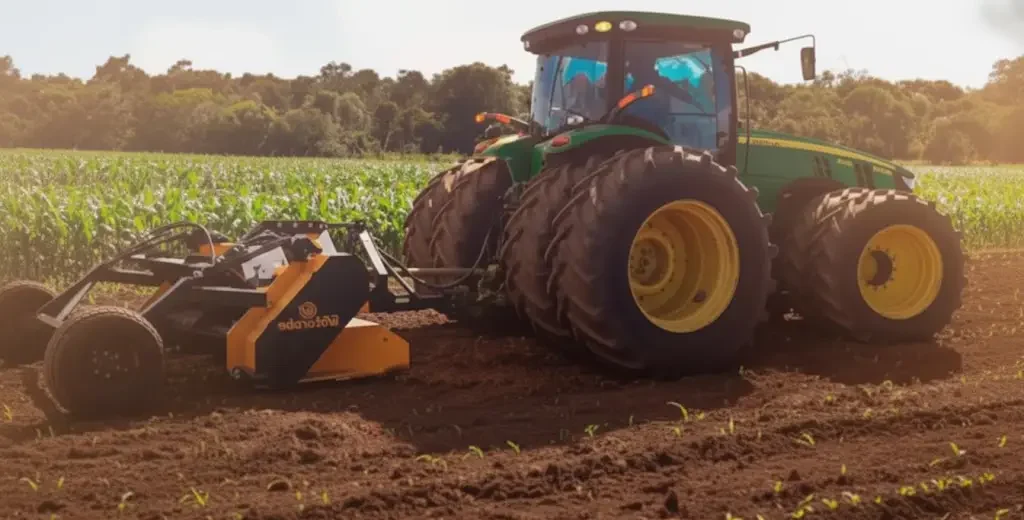
Road sub-base preparation is one of the most demanding applications for any stone crusher. The ground conditions — compacted stone layers, embedded rock of varying sizes, and hard sub-grade material — push machines to their operational limits in ways that typical arable field work does not. Choosing the wrong series, the wrong working depth, or the wrong tractor power results in incomplete processing, excessive tooth wear, and a sub-base that fails to meet bearing capacity requirements.
This guide explains how tractor stone crushers are used in road construction and rural infrastructure works, which series and configurations are appropriate for different project types, and how a stone crusher can be combined with a soil stabiliser to complete road sub-base preparation in a reduced number of machine passes.
Crusher vs traditional methods
Working depth & capacity for road work
STCM/HP series
STCH heavy-duty series
Pairing with a soil stabiliser
Project application cases
Tanya Jawab Umum
Stone Management in Road Construction
Road construction on previously agricultural or undeveloped land routinely encounters embedded stone that must be managed before the sub-base layer can be formed. In traditional road construction workflows, this stone is addressed through one of three approaches: mechanical breaking with hydraulic breakers mounted on excavators, excavation and off-site removal, or aggregate import to overlay the existing stone-laden material.
All three traditional methods share a significant cost disadvantage: they require either expensive specialist equipment, high haulage costs, or both. A tractor-mounted stone crusher offers a fourth option that eliminates the need for mechanical breaking, reduces haulage significantly, and produces a processed sub-grade surface in a single pass — at a fraction of the mobilisation cost of excavator-based breaking operations.
The stone crusher processes existing embedded material in place, reducing it to a size that can be incorporated into the compacted sub-base layer or removed by a following scarifier and roller operation. The result is a usable sub-grade surface ready for aggregate overlay or stabilisation treatment — without the cost of breaking and removing every stone individually.
High mobilisation cost. Slow output (m² per hour). Stone still present — must be removed or overlaid. Specialist operator required. Disrupts surrounding ground.
High haulage cost. Import of replacement material required. Long programme. Significant traffic generation on rural roads during construction.
Low mobilisation cost. High output (ha per day). Stone pulverised in place — incorporated into sub-grade. Standard tractor operator. Minimal ground disturbance beyond working depth.
Working Depth and Shredding Capacity for Road Applications
Road sub-base preparation imposes greater demands on working depth and shredding capacity than agricultural land preparation. The sub-base layer of a rural road or access track typically requires treatment to a depth of 150–250mm to address the full embedded stone horizon. Stone sizes in road construction contexts can also be significantly larger than in arable fields — particularly in post-glacial European soils or where the formation level crosses natural rock outcrops.
This directly determines which stone crusher series is appropriate for road and infrastructure work:
| APPLICATION | Tugas ringan (STCL) | HP kelas menengah (STCM/HP) | Tugas berat (STCH) |
|---|---|---|---|
| Capability | |||
| Max shredding diameter | 150 mm | 300mm | 500 mm |
| Kedalaman kerja maksimum | 150 mm | 200 mm | 250 mm |
| Rotor diameter | 450mm | 550mm | 700mm |
| Tractor power | 70–150hp | 200–280hp | 280–400hp |
| Road Application Suitability | |||
| Farm track & light access road | ✓ Suitable for surface stones under 150mm | ✓ Preferred — handles larger embedded stones | ✓ Luar Biasa |
| Rural road sub-base prep | Limited — depth and stone size often exceeded | ✓ Suitable for most rural road applications | ✓ Luar Biasa |
| Infrastructure / civil groundworks | Tidak cocok | ✓ Light to medium civil works | ✓ Primary specification |
| Large-scale road construction | Tidak cocok | Limited | ✓ Only appropriate series |
The light-duty STCL series — rated to 150mm shredding diameter and 150mm working depth — is not appropriate for road sub-base preparation where embedded stones are larger or the treatment depth exceeds 150mm. Using the STCL in these conditions results in rotor tooth overload and incomplete processing. Always specify mid-range HP or heavy-duty for road construction applications.
STCM/HP Series for Light Road and Infrastructure Preparation
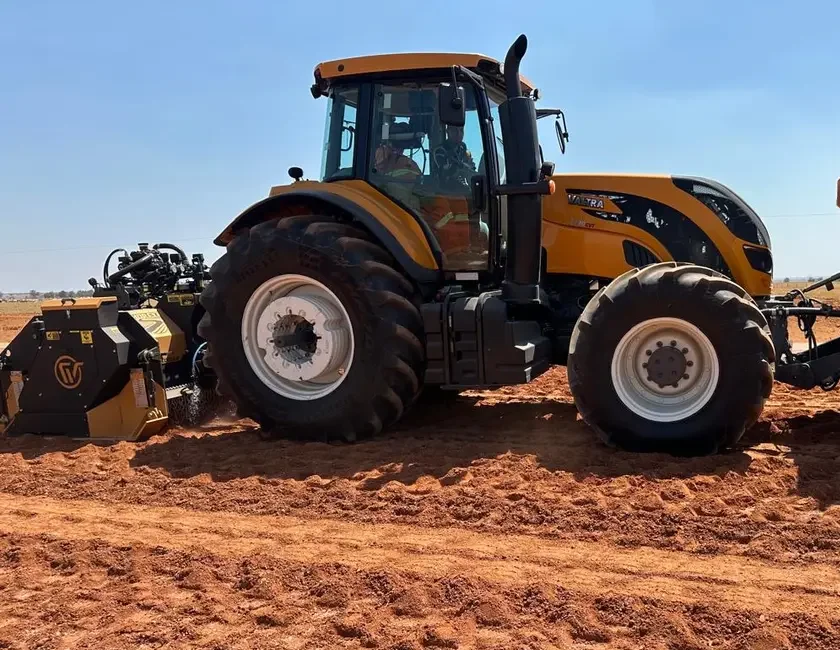
The STCM/HP series — rated for 200–280hp tractors — bridges the gap between professional arable contracting and light civil groundworks. With a 550mm rotor diameter, 300mm maximum shredding diameter, and 200mm working depth, it handles the stone sizes and treatment depths typical of farm track improvement, rural access road preparation, and light infrastructure groundworks across Europe. The power delivered to the rotor through the tractor’s PTO shaft in this configuration is substantial — for an overview of how PTO drive systems transmit that power from tractor to implement, see this pemandu poros PTO.
Suited to farm track improvement, rural access road preparation, and light civil groundworks where embedded stones up to 300mm are present and treatment depth requirements do not exceed 200mm. Wide 2,064mm working width maximises daily output on larger project sites.
The wider HP variant at 2,304mm — maximum daily output for 200–280hp tractors on open project sites. Best used on wider road formation works and larger groundwork sites where the full working width can be deployed without headland constraints limiting efficiency.
STCH Heavy-duty Series for Civil Infrastructure Works
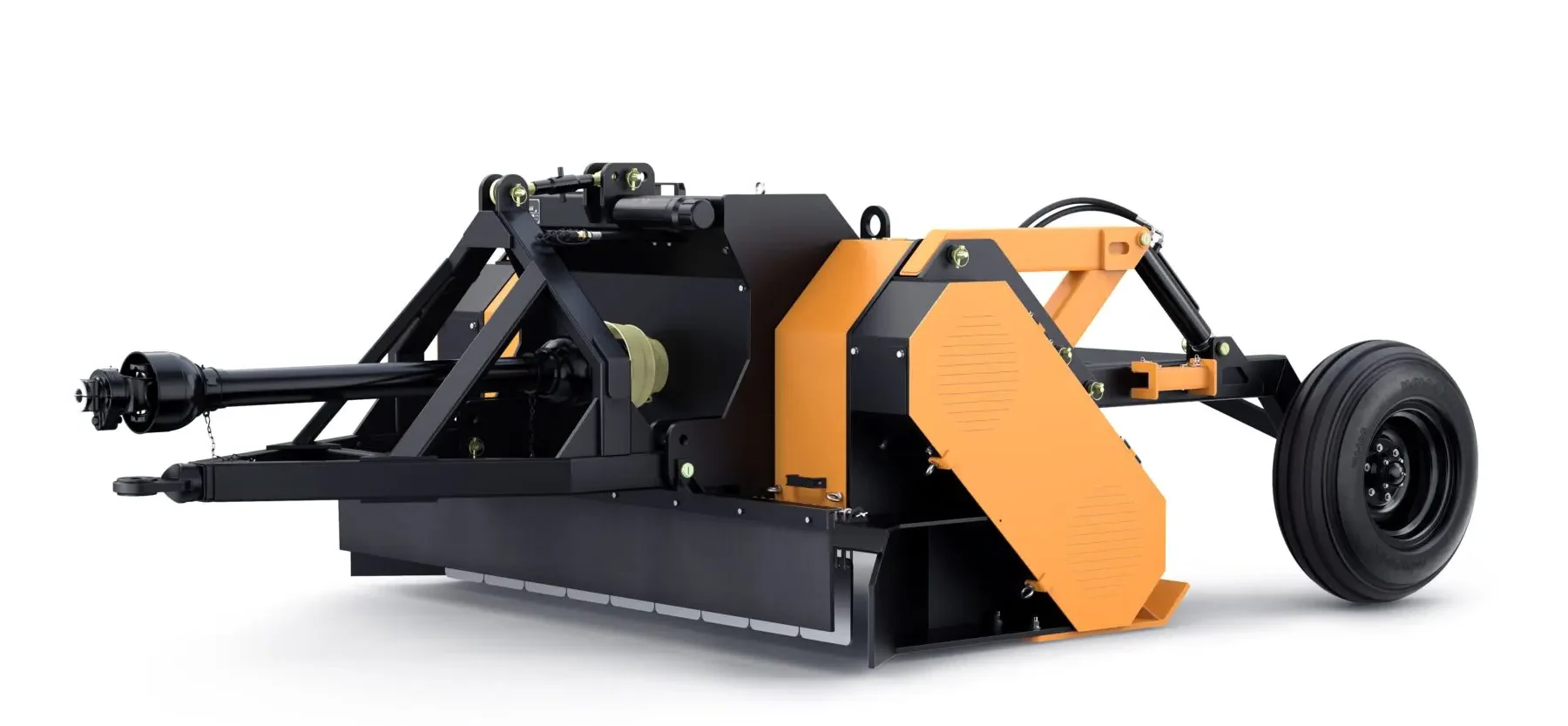
For large-scale road construction, infrastructure groundworks, and civil engineering projects where stone sizes exceed 300mm or treatment depth exceeds 200mm, the heavy-duty STCH series is the appropriate specification. Three configurations are available, all rated for 280–400hp tractors with 1000rpm PTO:
| SPESIFIKASI | STCH 200 | STCH 225 | STCH 250 |
|---|---|---|---|
| Performance | |||
| Tenaga traktor (hp) | 280–400 | 280–400 | 280–400 |
| PTO (rpm) | 1000 | 1000 | 1000 |
| Working width (mm) | 2,080 | 2,320 | 2,560 |
| Diameter penghancuran maksimum (mm) | 500 | 500 | 500 |
| Kedalaman kerja maksimum (mm) | 250 | 250 | 250 |
| Diameter rotor (mm) | 700 | 700 | 700 |
| Weight (kg) | 4,850 | 5,050 | 5,250 |
| No. teeth | 50+4+4 | 56+4+4 | 62+4+4 |
| Road Construction Capability | |||
| Max stone processed | 500mm diameter — handles the largest rocks encountered in European civil groundworks | ||
| Sub-base treatment depth | 250mm — covers the full sub-base horizon for most rural and light urban road formations | ||
| Daily output (at 1.5 km/h) | approx. 0.31 ha/hr | approx. 0.35 ha/hr | approx. 0.38 ha/hr |
The 700mm rotor diameter of the STCH series carries substantially more kinetic energy per tooth strike than the 550mm mid-range rotor — the difference is most evident in hard, compacted material where the rotor must maintain speed under sustained impact load. For sustained heavy civil groundwork operation, the STCH series maintains working efficiency in conditions that would stall or significantly slow a mid-range machine.
Pairing a Stone Crusher with a Soil Stabiliser
In road construction and infrastructure groundworks, stone crushing is rarely the last operation before aggregate overlay. On sub-grades with poor bearing capacity — common in clay-heavy or waterlogged European soils — the crushed stone surface still requires stabilisation with lime or cement before it can reliably support construction traffic and permanent road loading.
Combining a tractor stone crusher pass with a subsequent soil stabiliser operation produces a fully prepared sub-base in two passes — without the mobilisation cost of specialist stabilisation plant. The recommended sequence is:
Pulverise embedded stones to the required working depth, producing a broken and loosened sub-grade surface. Larger rocks are reduced to a processable fragment size that allows the following stabiliser rotor to mix binder effectively through the full treatment depth.
Apply lime or Portland cement to the surface at the design mix rate using a front-mounted binder spreader. Precise electronic dosing ensures uniform binder coverage across the full working width, eliminating the uneven distribution typical of manual bag-spreading methods.
The rear-mounted soil stabiliser mixes the applied binder into the processed sub-grade material in a single pass, producing a chemically stabilised layer with improved bearing capacity, frost resistance, and long-term load-bearing performance — ready for geotextile, aggregate overlay, and surface course.
This three-pass sequence — stone crusher, binder spreader, soil stabiliser — replaces a traditional road sub-base preparation programme that might involve excavator breaking, haulage, aggregate import, spreading, and compaction. For rural road improvement projects and farm track construction, the tractor-based approach reduces both programme duration and total plant cost significantly. Contact our team to discuss specification for your specific project type and formation level.
Project Application Cases
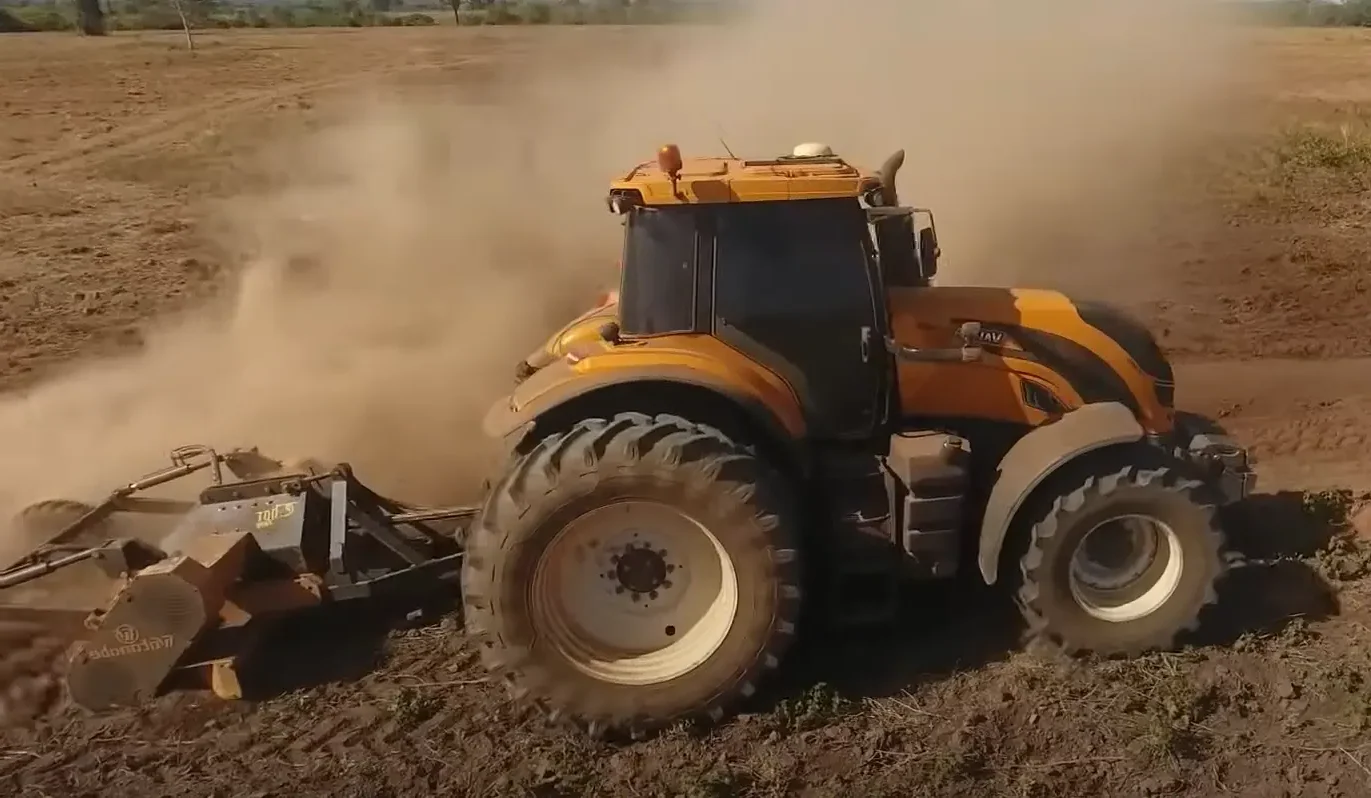
Tractor stone crushers are regularly deployed across four road and infrastructure project types in Europe:
Loose surface stones on farm tracks cause tyre damage, reduced traction, and uneven surfaces that slow harvest logistics. A stone crusher pass consolidates surface and shallow sub-surface stones into the track base, improving load-bearing capacity and all-weather trafficability for heavy harvest machinery without importing aggregate. The STCM/HP series at 200–280hp is the standard specification for this application across the Netherlands, Belgium, and UK.
Rural road improvement programmes across northern Europe routinely encounter post-glacial stone deposits at formation level. The STCH series processes these deposits to 250mm depth, reducing embedded stones up to 500mm diameter and producing a broken sub-grade layer ready for stabilisation or aggregate overlay. A single STCH pass across a rural road formation eliminates the need for the hydraulic breaker operations that would otherwise be required to deal with larger embedded material.
New industrial and logistics developments on previously agricultural land in the Netherlands, Belgium, and Germany frequently require formation level preparation over large areas. The STCH series combined with a soil stabiliser provides a cost-effective approach to preparing large ground floor slabs and hardstanding areas — processing embedded stone in place and improving sub-grade bearing capacity without excavation and aggregate import across the full site area.
General aviation airfields and agricultural airstrips across Europe require periodic sub-base improvement as embedded stone works to the surface over time. The STCH series combined with lime stabilisation provides a reliable sub-base preparation method for grass airfield improvements where the uniform binder dosing and deep sub-grade treatment deliver the consistent bearing capacity required for light aircraft operations.
Pertanyaan yang Sering Diajukan
For stones within the crusher’s rated shredding diameter (up to 500mm for the STCH series), yes — and at significantly lower mobilisation and operating cost. For boulders substantially larger than 500mm, or where the formation level crosses solid bedrock, a hydraulic breaker is still required to pre-break the material before the stone crusher can process it. The two approaches are complementary on projects with varied stone sizes rather than strictly alternatives.
A stone crusher processes and redistributes existing material in place — it does not produce graded aggregate to a specific particle size distribution. The output is a broken, loosened sub-grade with significantly reduced maximum particle size. For roads requiring a specific graded sub-base layer to an engineering specification, additional aggregate import and compaction will still be required above the crusher-treated formation. The crusher’s role is to prepare the formation level for overlying works — not to replace imported sub-base material.
For road and civil works applications with significant embedded stone, a forward speed of 0.8–1.5 km/h is typically appropriate — slower than typical arable field work. The reduced speed allows the rotor more tooth strikes per metre of ground, ensuring complete pulverisation of larger stones before the machine passes. In lighter stone concentrations or for farm track surface improvement, speed can be increased to 2–3 km/h without compromising result quality.
Yes. Watanabe Netherlands supplies stone crushers across Europe, with confirmed delivery capability to the UK, Netherlands, Belgium, France, Germany, and beyond. CE certification is provided as standard with every machine, supporting operation on commercial sites across EU and UK jurisdictions. For contractors requiring multiple units or specific delivery schedules tied to project programmes, contact our team at [email protected] to discuss supply arrangements.
Specifying a Stone Crusher for a Road or Infrastructure Project?
Tell us your project type, formation level stone conditions, required working depth, and tractor power — our team will confirm the right series and configuration and provide a no-obligation delivery quotation across Europe.