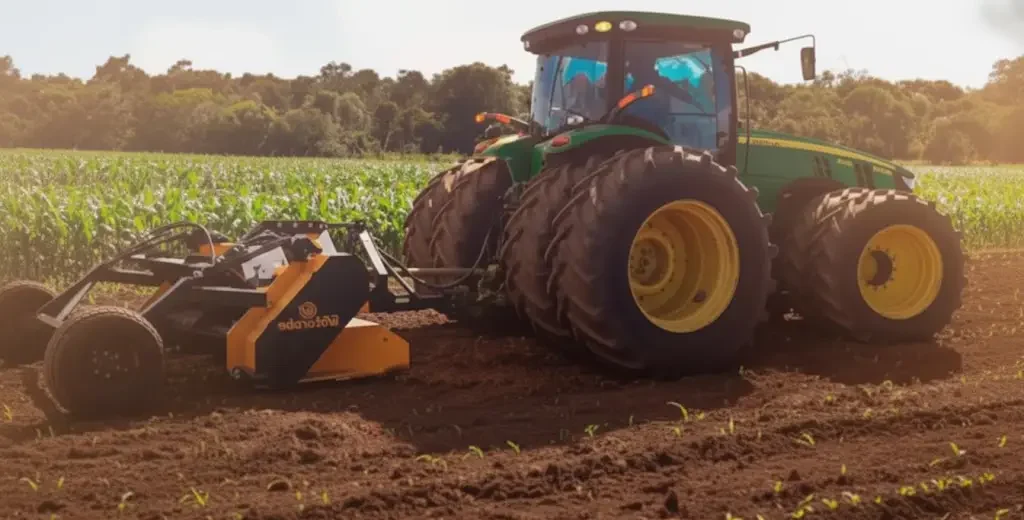
Tractor horsepower is the single most important factor in matching a stone crusher to your operation. Too little power and the machine struggles through dense stone concentrations, the rotor slows below its design speed, and crushing quality drops — along with daily output. Too much power for the working width chosen and you are paying to run an oversized tractor on a machine that could be driven by something half the size.
This guide maps every tractor horsepower band from 70hp to 400hp to the stone crusher configurations compatible with it, explains the role of PTO speed alongside horsepower, and gives specific model recommendations for each power range. For a broader introduction to how stone crushers work, see this stone crusher overview.
The three power ranges
540rpm vs 1000rpm PTO
70–100hp tractors
100–150hp tractors
150–220hp tractors
200–280hp tractors
280–400hp tractors
Can you overpower?
Συχνές ερωτήσεις
Why Horsepower Matters for Stone Crushers
A stone crusher rotor relies on kinetic energy to pulverise stone. That energy comes from the rotor’s mass and its rotational speed — and rotational speed is maintained by the tractor’s PTO output power. When tractor power falls short of the machine’s requirement, the rotor slows under load. A slower rotor carries less kinetic energy per tooth strike, which means:
Stones are fractured but not fully pulverised. Oversized fragments remain in the soil and continue to cause equipment damage in following operations.
At reduced rotor speed, stones absorb more impact energy per tooth strike rather than fracturing cleanly. This concentrates wear on individual teeth and reduces their operating life significantly.
An underpowered combination must work at a slower forward speed to prevent rotor stall. Daily hectares per hour drops, increasing the cost per hectare treated.
The horsepower recommendation for each model is the minimum sustained PTO power required to maintain rotor speed at the rated working speed in the machine’s design soil conditions. Always work within the stated range — and where your operation involves unusually hard or dense stone, operate at the upper end of your tractor’s power capability.
The Three Power Ranges at a Glance
The full stone crusher range divides into three series, each built around a different rotor diameter and power bracket:
| SPECIFICATION | Light-duty | Mid-range | Heavy-duty |
|---|---|---|---|
| Power & Drive | |||
| Tractor power (hp) | 70 – 150 | 80 – 280 | 280 – 400 |
| PTO speed | 540 or 1000rpm (ST) / 1000rpm (DT) | 540 or 1000rpm (ST125) / 1000rpm (others) | 1000rpm |
| Rotor diameter (mm) | 450 | 550 | 700 |
| Capability | |||
| Max shredding diameter (mm) | 150 | 300 | 500 |
| Max working depth (mm) | 150 | 200 | 250 |
| Working widths available (mm) | 1,110 – 2,070 | 1,340 – 2,304 | 2,080 – 2,560 |
| Machine weight range (kg) | 1,230 – 1,750 | 1,850 – 3,840 | 4,850 – 5,250 |
| Best Application | |||
| Typical use | Vineyards, orchards, small–medium arable | Large arable, contracting, road prep | Civil works, heavy contracting, reclamation |
540rpm vs 1000rpm PTO — Does It Matter?
PTO speed and tractor horsepower are related but separate factors. A tractor may deliver 120hp at either 540rpm or 1000rpm PTO output — but the stone crusher’s performance will differ significantly between these two inputs, even from the same tractor.
- Standard on most pre-2000 European tractors
- Available on most modern tractors as an economy setting
- Rotor turns at lower speed → less kinetic energy per tooth strike
- Suitable for ST variants in light-to-medium stone conditions
- Not recommended for DT or HP variants — below design threshold
- Standard on modern European tractors from 80hp upward
- Higher rotor speed → significantly more kinetic energy
- Better crushing performance on harder and denser stone
- Required for all DT and HP variants
- Recommended for all ST variants where available on the tractor
If your tractor offers both 540rpm and 1000rpm PTO outputs, always run the stone crusher at 1000rpm. The difference in rotor energy between the two speeds is approximately 3.4x — meaning a machine run at 1000rpm has more than three times the crushing energy available per tooth strike compared to the same machine at 540rpm.
70–100hp Tractors: What Can They Run?
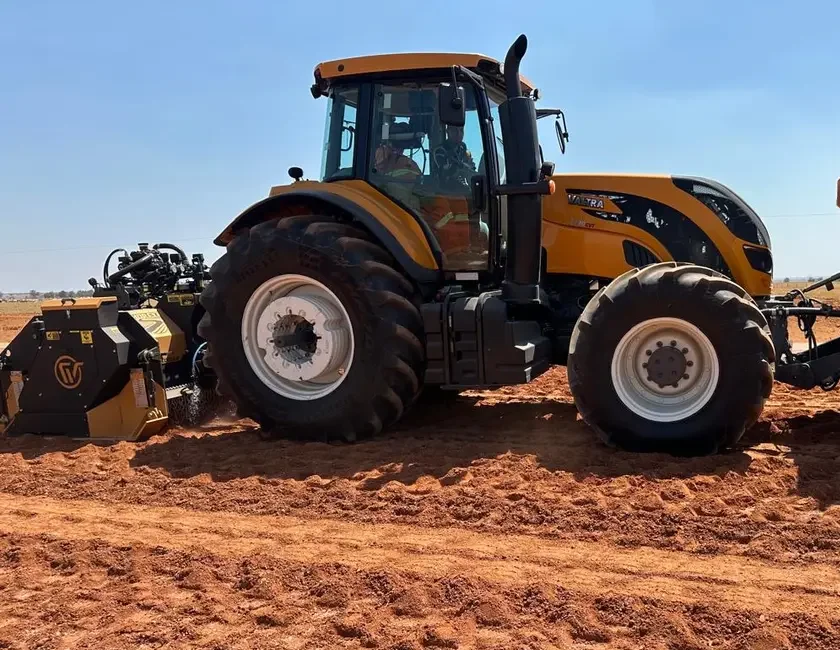
Tractors in the 70–100hp range are the workhorses of small-to-medium European farms, vineyard operations, and specialist contractors. Two light-duty stone crusher configurations are available in this power bracket:
The narrowest model in the range at 1,110mm working width — the right choice for vineyard and orchard row clearance, and for small farms with older 70–80hp tractors running 540rpm PTO. Dual 540/1000rpm compatibility ensures broad tractor compatibility.
Slightly wider at 1,350mm — the most popular vineyard and small-farm configuration. From 80hp upward with 540 or 1000rpm PTO, this model covers a wide range of compact tractors commonly used across the Netherlands, Belgium, and UK horticultural operations.
At the lower end of this bracket (70–80hp), work at a reduced forward speed — approximately 1.0–1.5 km/h — to maintain rotor speed in stony conditions. In lighter stone concentrations, speed can be increased. The STCL/ST 100 and ST 125 are both designed for this power range and will perform reliably within their rated parameters.
100–150hp Tractors: More Options Open Up
At 100–150hp, you have access to the full light-duty range and the entry point to the mid-range series. Four light-duty configurations and one mid-range entry model are available:
| MODEL | STCL/ST 150 | STCL/ST 175 | STCL/DT 175 | STCL/DT 200 | STCM/ST 125 |
|---|---|---|---|---|---|
| Specifications | |||||
| Engine power (hp) | 90–120 | 100–120 | 100–150 | 120–150 | 80–110 |
| PTO (rpm) | 540–1000 | 540–1000 | 1000 | 1000 | 540 or 1000 |
| Working width (mm) | 1,590 | 1,830 | 1,830 | 2,070 | 1,340 |
| Max shredding dia. (mm) | 150 | 150 | 150 | 150 | 300 |
| Max working depth (mm) | 150 | 150 | 150 | 150 | 200 |
| Weight (kg) | 1,440 | 1,570 | 1,600 | 1,750 | 1,850 |
At this power bracket, you choose between a wider light-duty machine (max 150mm stone, to 150mm depth) or the STCM/ST 125 entry to the mid-range (max 300mm stone, to 200mm depth). If your stones are consistently under 150mm and your fields are open arable, the STCL/DT 200 at 2,070mm working width gives maximum output. If you have larger stones or need deeper working, the STCM/ST 125 is the right step up — even at a narrower 1,340mm width.
150–220hp Tractors: Mid-range Territory
This is the core bracket for professional arable contractors and large farm operations across northern Europe. Four standard STCM configurations are available:
| MODEL | STCM 150 | STCM 175 | STCM 200 | STCM 225 |
|---|---|---|---|---|
| Specifications | ||||
| Engine power (hp) | 150–220 | 160–220 | 170–220 | 180–220 |
| PTO (rpm) | 1000 | 1000 | 1000 | 1000 |
| Working width (mm) | 1,584 | 1,824 | 2,064 | 2,304 |
| Max shredding dia. (mm) | 300 | 300 | 300 | 300 |
| Max working depth (mm) | 200 | 200 | 200 | 200 |
| Weight (kg) | 3,000 | 3,250 | 3,550 | 3,800 |
All four models require 1000rpm PTO. The working width progression from 1,584mm to 2,304mm maps directly to increasing tractor power — match the working width to your tractor’s available horsepower, not the maximum in the series. A 160hp tractor running the STCM 225 at 2,304mm will be at the limit of its power output; pairing it with the STCM 175 at 1,824mm gives a better operating margin and higher sustained daily output.
200–280hp Tractors: High-Power Mid-range Variants
At 200–280hp, the STCM/HP (High Power) variants become available. These share the same working widths as the standard STCM 200 and 225, but are built with reinforced rotor components and increased throughput capacity for sustained operation at higher power inputs and in more demanding ground conditions:
Reinforced for high-power tractor operation. Same 2,064mm working width as the standard STCM 200 but built for sustained 200–280hp input — suitable for demanding arable contracting and light road sub-base preparation work.
The widest mid-range configuration at 2,304mm — maximum daily output for high-power tractors in open arable or contracting applications. At 200–280hp, this model covers the output demands of professional European contractors without stepping up to the heavy-duty series.
If your tractor is in the 170–220hp range, the standard STCM 200 or 225 is the correct choice. The HP variants are specifically built for sustained 200–280hp operation and are over-specified for tractors at the lower end of that range. Contact our team with your exact horsepower and we will confirm the right model.
280–400hp Tractors: Heavy-duty Range
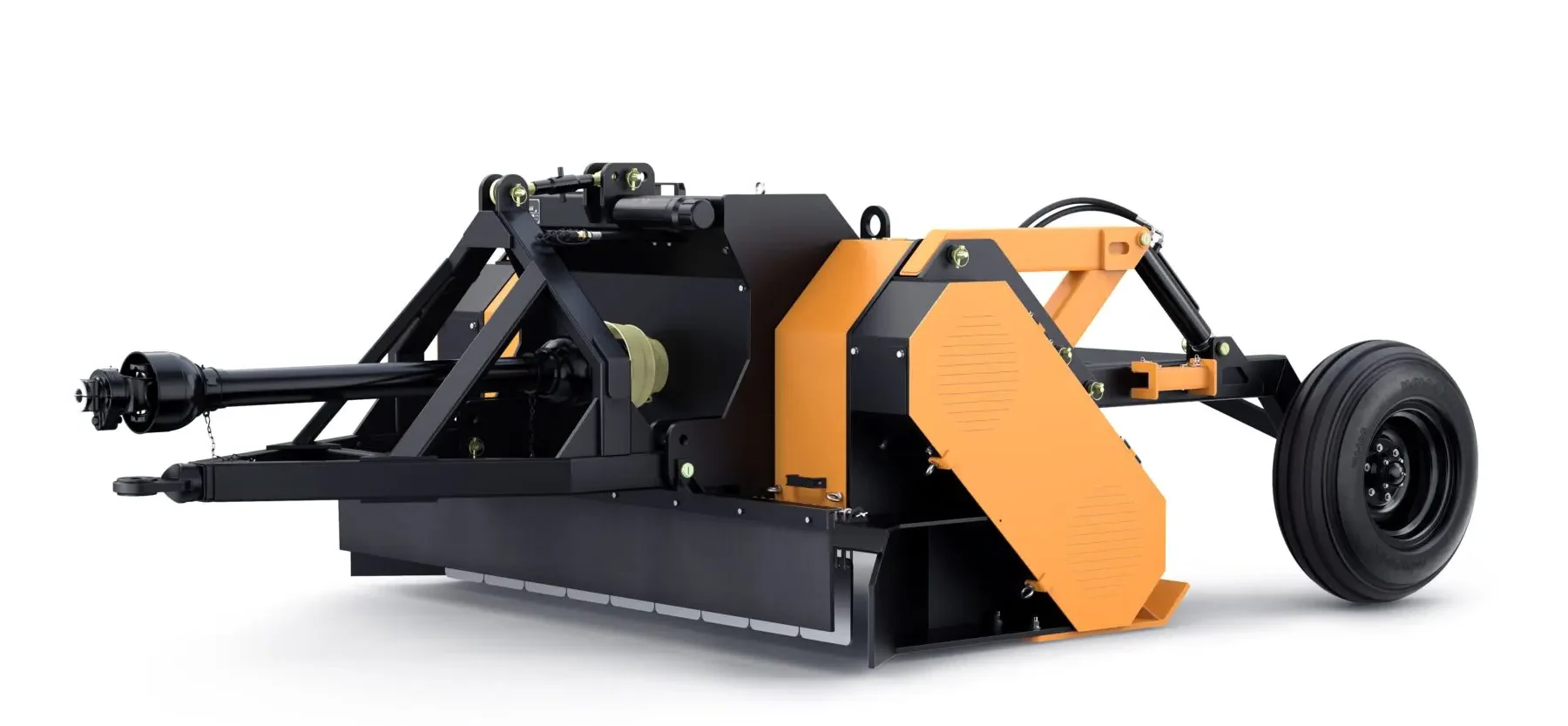
At 280–400hp, the heavy-duty STCH series becomes available. Three configurations cover working widths from 2,080mm to 2,560mm, with the largest rotor in the range at 700mm diameter — capable of processing stones up to 500mm and working to 250mm depth:
| MODEL | STCH 200 | STCH 225 | STCH 250 |
|---|---|---|---|
| Specifications | |||
| Engine power (hp) | 280–400 | 280–400 | 280–400 |
| PTO (rpm) | 1000 | 1000 | 1000 |
| Working width (mm) | 2,080 | 2,320 | 2,560 |
| Max shredding dia. (mm) | 500 | 500 | 500 |
| Max working depth (mm) | 250 | 250 | 250 |
| Weight (kg) | 4,850 | 5,050 | 5,250 |
| No. teeth | 50+4+4 | 56+4+4 | 62+4+4 |
All three STCH models operate at 1000rpm PTO only and are designed for Category 3 rear linkage systems standard on high-power European tractors. For operators in the 280–320hp range, the STCH 200 (2,080mm) provides a good power-to-width ratio with headroom for demanding ground conditions. At 320–400hp, the STCH 225 or STCH 250 can be run at full working width without compromising working speed.
Can You Overpower a Stone Crusher?
Yes — and it is a real risk that buyers sometimes overlook. Running a stone crusher with a tractor significantly above the machine’s rated power range creates two problems:
A machine rated for 150hp maximum being driven by a 250hp tractor will experience torque inputs and shock loads beyond its design specification. Drive belts, gearbox components, and the rotor mounting structure are all sized for the rated power range. Exceeding it causes premature failure of these components — typically not covered under warranty.
A high-powered tractor running a light machine may be tempted to increase forward speed above the machine’s rated working speed. Excessive forward speed reduces the number of tooth strikes per metre of ground, leaving stones partially crushed and creating an uneven finish.
Stay within ±20% of the model’s rated power range for optimal performance and machine longevity. If you plan to upgrade your tractor in the near future, consider specifying the next series up now — it gives you headroom and will often result in lower tooth wear per hour at your current power level.
Συχνές ερωτήσεις
Yes, but with some caveats. Operating at the minimum rated power means the tractor is working at close to maximum PTO load. In very stony or hard ground conditions, you may need to reduce working speed to prevent rotor slow-down. In lighter stone conditions, the minimum rating will be sufficient. Tractors at the lower end of the rated bracket often benefit from running at 1000rpm PTO where available — it maintains rotor speed at lower forward speeds more effectively than 540rpm.
At 130hp you have two good options. If your stones are consistently under 150mm and working depth of 150mm is sufficient, the STCL/DT 175 or DT 200 (1,830mm or 2,070mm working width) gives maximum output within the light-duty range. If you have larger stones up to 300mm or need 200mm working depth, the STCM/ST 125 (1,340mm, 80–110hp rated) is under-matched at 130hp — contact our team to confirm whether a mid-range model is compatible with your specific tractor at that power level.
PTO horsepower is what drives the rotor — but it is typically quoted as engine horsepower on most European tractor specifications. PTO power is usually 10–15% lower than engine power due to driveline losses. The horsepower figures quoted in stone crusher specifications refer to engine (gross) horsepower as stated in tractor spec sheets. You do not need to make any adjustment — just use the engine HP from your tractor’s specification document.
Yes — this is the most common pre-order enquiry we handle. Contact us at [email protected] with your tractor make, model, engine horsepower, PTO speed options, rear linkage category, and a description of your stone conditions. We will confirm the right series and working width, check rear linkage compatibility, and provide a delivery quotation to your location across Europe.
Find the Right Stone Crusher for Your Tractor HP
Tell us your tractor make, model, and horsepower — our team will confirm the right series, working width, and PTO configuration, and provide a no-obligation delivery quotation across Europe.