Forestry sites present a set of ground conditions that agricultural and civil engineering equipment rarely encounters together in the same location: buried root systems, large surface and subsurface rocks exposed by excavation, compacted logging tracks, and soil profiles disturbed by decades of heavy machine movement. When timber extraction is complete and a site needs to be returned to productive use — whether for reforestation, agricultural conversion, or road construction — a tractor-mounted stone crusher is consistently the most effective first-pass tool for restoring trafficable, workable ground. This guide explains why, and how European forestry operators and contractors are applying the technology across Scandinavia, central Europe, and the British Isles.
What Forestry Ground Conditions Actually Demand
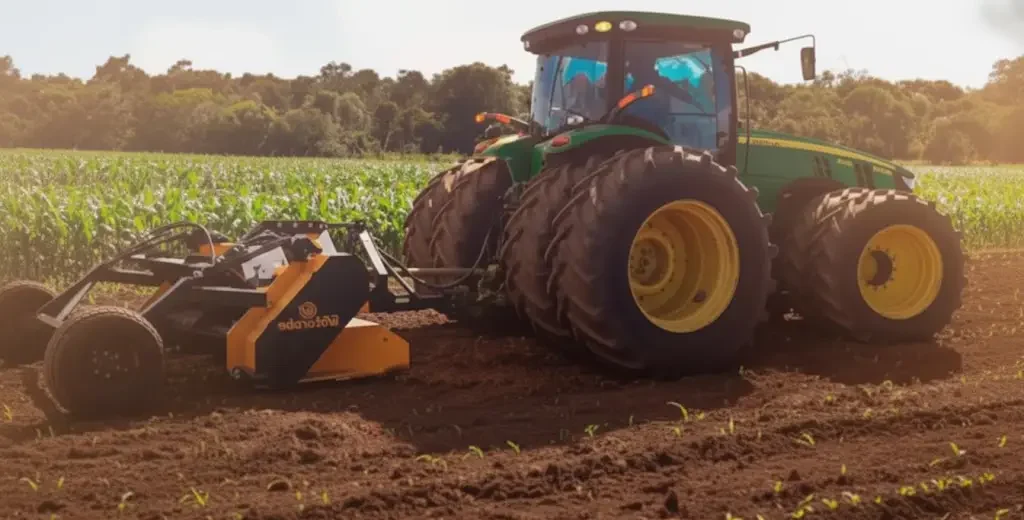
A cleared forestry site is rarely just a flat open area ready for the next operation. Logging machinery — forwarders, harvesters, skidders — leaves behind deeply rutted tracks, compacted headlands, and significant quantities of stone material that has been pushed to the surface by root upheaval and machine passage. In glacially deposited soils common across northern Europe, stones of 200 mm to 400 mm diameter are embedded in the upper 300 mm of the soil profile and emerge progressively as the surface is disturbed.
Attempting to till, seed, or grade these surfaces without first addressing the stone content damages rotavators, ploughs, graders, and seeding equipment. Attempting to lay a road base over unprocessed surface rock produces an unstable foundation that rutts immediately under the first vehicle loads. The stone crusher resolves both problems by processing the existing surface material — rock, gravel, compacted mineral soil, and organic debris — into a homogeneous, fine-grained layer that subsequent operations can work with directly.
This is the fundamental reason stone crushers have become standard equipment in Scandinavian and central European forestry operations: they do not remove the problem from site — they convert it into a usable resource, in a single machine pass, without the cost and logistics of excavation and material disposal.
The Four Main Forestry Applications
Post-Logging Site Reclamation for Reforestation
After timber extraction, the top priority for reforestation contractors is producing a seedbed that allows planting machinery to operate without obstruction. Stone content above 150 mm diameter prevents mechanical planting heads from achieving consistent planting depth, and large surface rocks damage planting equipment in rocky terrain. A stone crusher pass at 150–200 mm working depth reduces surface stone to below the critical size threshold in a single pass across the cleared area. The processed material is left in place, improving the mineral soil structure and providing drainage aggregate for the developing root system. In Scandinavian practice, this approach replaces the traditional disc-trencher pre-treatment on rocky sites and reduces site preparation time by 40–60% on moderately stony ground.
Forest Road Construction and Maintenance
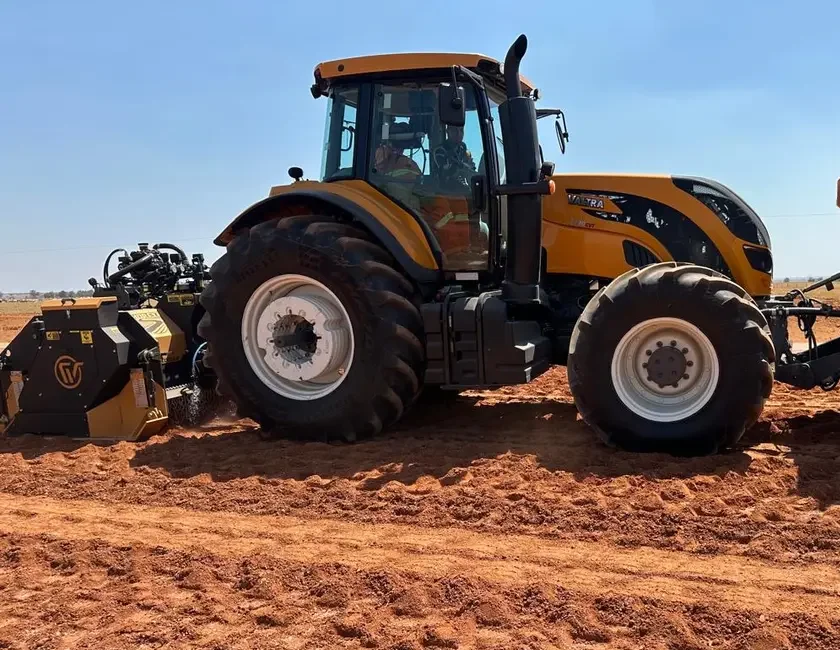
Permanent and semi-permanent forest access roads must carry forwarder loads of 20 tonnes or more on axles separated by short wheelbases — conditions that expose any weak spots in a road base immediately. Building these roads by importing crushed aggregate is expensive and logistically complex in remote locations. A stone crusher processing the existing native rock and gravel on-site produces a base layer aggregate at zero material cost. The heavy-duty THOR 3.0 AR, operating on a 280 hp tractor, can process a 3.0 m wide strip at 250 mm depth in a single pass, producing a compacted gravel surface ready for use after a single roller pass. In the Friesland region of the Netherlands, dairy farmers clearing glacial stone-infested pastures adjacent to forestry blocks used this method to build 2 km of permanent farm tracks at the material cost of fuel alone.
Agricultural Conversion of Former Forestry Land
Converting cleared forest land to arable or pasture agriculture requires removing or reducing the stone content to a level that allows normal cultivation machinery to operate safely. Former forestry soils are often the most stone-dense agricultural land encountered in Europe — decades of deep root growth and freeze-thaw cycles bring subsurface material to the surface progressively after tree removal. A heavy-duty stone crusher at 250 mm depth processes the material that would otherwise destroy a plough or subsoiler on first contact. In Germany, the Mosel Valley provides a well-documented case: steep vineyard terraces established on former woodland required slate fragment processing before vine row planting could proceed. The stone crusher completed this work three weeks ahead of the alternative topsoil strip-and-replace schedule, at approximately 65% lower cost per hectare.
Firebreak and Infrastructure Corridor Preparation
Forestry management plans in southern and central Europe increasingly require maintained firebreaks and equipment access corridors between plantation blocks. These strips must be kept clear of vegetation and trafficable by emergency vehicles year-round. A stone crusher pass produces a stable mineral surface that suppresses vegetation regrowth through shading of the soil surface and eliminates the stone hazards that damage equipment tyres on emergency access routes. The mid-range THOR 2.4 AR, manageable on a 180 hp tractor, is well-suited to these corridor applications where the working width matches standard firebreak specifications in Spanish and Portuguese forest management guidance.
Choosing the Right Machine for Forestry Conditions
Forestry applications place different demands on a stone crusher than vineyard or arable work. The stone sizes tend to be larger, the working depths deeper, and the operating conditions rougher — uneven terrain, hidden root systems, and occasional buried large boulders. Machine selection must reflect these conditions rather than standard agricultural duty cycles.
| Forestry Application | Recommended Series | Key Specification | Tractor Requirement |
|---|---|---|---|
| Reforestation seedbed prep — moderate stone | STCL / STCM light-mid | 150–300 mm stone, 150–200 mm depth | 80–180 hp |
| Forest road construction — heavy stone | THOR 3.0 AR | Up to 500 mm stone, 3.0 m width, 250 mm depth | 230 hp minimum |
| Agricultural conversion — large boulders | STCH heavy-duty | Up to 500 mm stone, 700 mm rotor, 250 mm depth | 280–400 hp |
| Firebreak / access corridor maintenance | THOR 2.4 AR | 2.4 m width, regular seasonal passes | 180 hp minimum |
One specification that matters particularly in forestry is rotor inertia. A larger rotor diameter — 700 mm on the STCH heavy-duty series versus 450 mm on the light-duty STCL — carries significantly more rotational energy. When the rotor encounters an unexpected large boulder, the inertia carries it through the impact without stalling the machine. Light-duty machines on heavy forestry stone may stall repeatedly, damaging the drivetrain and producing a severely degraded hourly output. Matching the rotor specification to the actual stone size range on site is more important in forestry than in any other application.
Operating Adjustments for Forestry Sites
Forestry conditions require several operational adjustments compared with standard agricultural stone crusher practice. These are not optional refinements — they are the difference between productive daily output and repeated machine damage on difficult ground.
Reduce working speed on first pass
On a site with unknown stone distribution, begin at half the normal working speed — typically 0.3–0.5 km/h rather than 1–2 km/h. This gives the rotor time to process large material without peak shock loading. Once the surface material is reduced, subsequent passes can proceed at normal speed.
Set working depth conservatively initially
Start at 150 mm depth for the first pass across unfamiliar forestry ground. This allows the rotor to process the dominant surface stone before deeper material is engaged. A second pass at full target depth then works in already-processed material, reducing peak load and producing more homogeneous output gradation.
Open the rear door wider than standard
Forestry material contains a higher proportion of organic content — root fragments, bark, and woody debris — than agricultural stone. A more open rear door setting allows this material to pass through without blocking the crushing chamber. Adjust progressively until the output is predominantly mineral without organic accumulation at the door.
Increase tooth inspection frequency
Forestry stone is typically harder and more angular than the rounded agricultural field stones found in arable soils. Granite and gneiss — common in Scandinavian and upland British forestry — are significantly more abrasive than limestone. Reduce the tooth wear check interval to every 30 hours on granite-dominated sites rather than the standard 50-hour interval.
Pre-survey for buried infrastructure
Former forestry sites may have buried drainage pipes, old fence posts, or historic track foundations that do not appear on current maps. A visual survey and, on sensitive sites, a ground-penetrating radar pass before commencing stone crusher operations prevents rotor damage from steel or concrete buried objects — the only material category that a carbide-tipped rotor cannot process safely.
Use rock rake as a first pass on heavy boulder sites
On sites with boulders exceeding 500 mm diameter — beyond the crushing capacity of any tractor-mounted machine — a rock rake pass first removes or windrows the largest material. The stone crusher then processes what remains, working within its design envelope rather than encountering material it cannot handle.
Combining the Stone Crusher with Other Equipment on Forestry Projects
The stone crusher is rarely the only machine working on a forestry reclamation project. It operates as part of a coordinated equipment sequence, and the order of operations determines the quality of the final result.
Recommended Equipment Sequence — Forestry Reclamation
Rock Rake — surface clearing
Removes boulders above 400 mm diameter and windrows them for later disposal or landscape use. Clears the surface for the crusher to operate within its capacity range.
Stone Crusher — main processing pass
Processes all material within its capacity range to the target particle size and depth. This is the primary value-adding operation — converting unusable surface material into a uniform processed layer.
Rock Picker — residual fines collection (reforestation only)
On sites designated for mechanical planting, a rock picker removes any residual fragments above the planting machinery tolerance threshold. This step is unnecessary for road construction or pasture conversion.
Rotavetor — final tilth preparation (agricultural conversion)
For sites converting to arable use, a rotavetor pass after stone crushing produces the fine seedbed structure needed for direct seeding. The stone-free surface means the rotavetor operates at normal speed without stone strikes.
Soil Stabilizer — road base construction (infrastructure projects)
Where the stone-crushed material is to form a structural road base, a soil stabilizer pass incorporating cement or foam bitumen transforms the processed aggregate into a bound, load-bearing layer. The crusher provides the correct material gradation that the stabilizer requires.
Watanabe Netherlands supplies stone crushers, rock rakes, rock pickers, and rotavetors as a coordinated equipment range — enabling contractors to source the full equipment sequence from a single Dutch supplier with one technical support team, one parts network, and one delivery lead time. The full stone crusher range, including THOR 2.4 AR and THOR 3.0 AR configurations suited to forestry work, is detailed on the product section.
For forestry contractors who also operate rotary cutting equipment for brash management and vegetation clearance between stone crusher operations, SSJ Group provides a comprehensive range of rotary cutter gearboxes suited to heavy-duty forestry and land clearance applications — a complementary component for the broader equipment ecosystem used in post-logging site management.
Documented Results: What European Forestry Operators Achieve
40–60%
Reduction in site preparation time versus strip-and-replace on moderately stony reforestation sites
65%
Lower cost per hectare for vineyard terrace stone processing versus conventional topsoil removal and replacement
0 t
Material imported for on-site stone processing — all output stays on the site as usable aggregate
These outcomes are consistent across documented European projects. The common factor is the same in every case: the stone crusher converts a problem — surface rock that prevents the next operation — into a resource, at a cost determined entirely by fuel and machine hours rather than material purchase, transport, and tipping fees.
For contractors evaluating a specific forestry reclamation project, the THOR 2.4 AR and THOR 3.0 AR represent the two most commonly deployed configurations in European forestry contexts. Specifications for both, including tractor compatibility, working width, and maximum stone diameter, are available on the THOR 3.0 AR product page.
Planning a Forestry Reclamation Project?
Tell us your site area, stone size range, tractor horsepower, and end-use objective — reforestation, road construction, or agricultural conversion. Our Netherlands team will recommend the right machine configuration and provide a quotation within 24 hours.