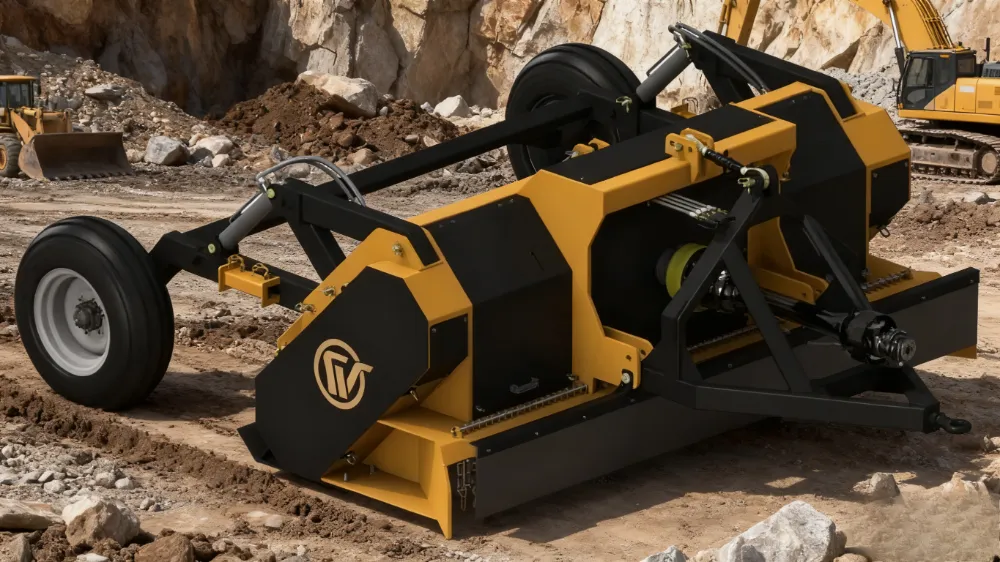
If you farm or contract on land where stones are a recurring problem, a tractor stone crusher is one of the most practical investments you can make. Stones damage tillage equipment, reduce seedbed quality, slow harvest operations, and complicate road and foundation preparation. A tractor stone crusher eliminates these problems permanently — in a single pass, without removing material from the field.
This guide explains what a tractor stone crusher is, how it works mechanically, what different machines can process, and how to understand the key specifications before you buy.
How does it work?
Key components
Stone size & working depth
Stone crusher vs mulcher
Where they are used
التعليمات
What Is a Tractor Stone Crusher?
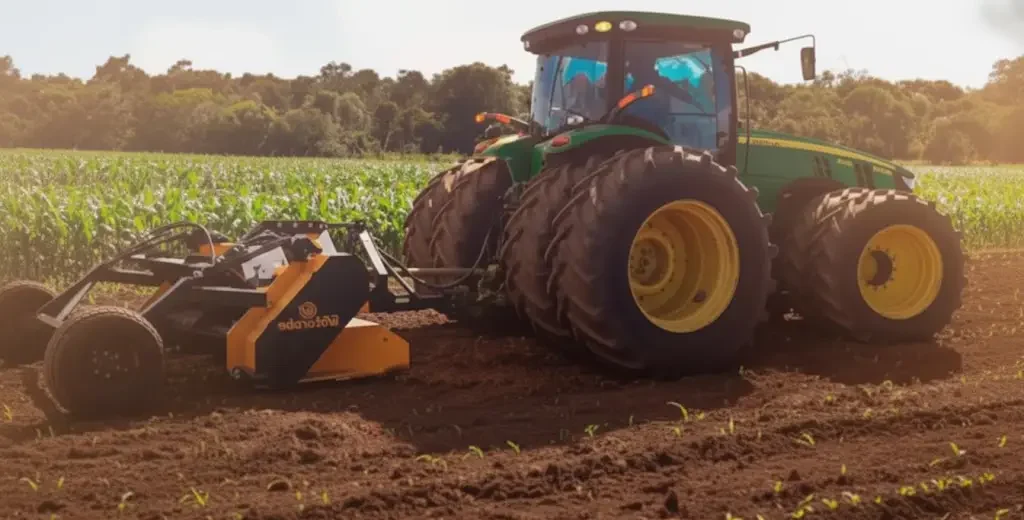
A tractor stone crusher — also called a PTO stone crusher or آلة تكسير الحجارة بالجرار — is a rear-mounted implement attached to a tractor via the standard three-point linkage system. It is powered directly by the tractor’s power take-off (PTO) shaft, which drives a high-speed rotor inside the machine housing.
Unlike industrial jaw crushers or impact crushers used in quarrying, a tractor stone crusher is designed for in-situ operation. It does not collect or remove stones — instead, it pulverises them into small fragments and returns the material directly to the soil in the same pass. The result is a clean, stone-free seedbed or working surface without the cost and logistics of stone collection, loading, and removal.
Tractor stone crushers are widely used across European agriculture, civil contracting, and infrastructure maintenance — from vineyard and orchard preparation to road sub-base treatment and large-scale land clearing. For a broader overview of stone crusher types, see this stone crusher reference guide.
How Does a Tractor Stone Crusher Work?
The operating principle is straightforward, but the engineering behind it is precise. Here is the full sequence from tractor PTO to finished surface:
The tractor’s PTO shaft — running at 540rpm or 1000rpm depending on the model — connects to the crusher’s input shaft. Rotational power is transmitted through a drive belt or gearbox to the rotor. Drive components are engineered to handle the high shock loads generated by stone impact during operation.
The rotor spins at high speed inside the armoured housing. Hardened, replaceable teeth are fixed across its full working width. Rotor diameter determines kinetic energy — 450mm for light-duty, 550mm mid-range, 700mm heavy-duty — and therefore the maximum stone size the machine can process.
As the machine moves forward, rotor teeth penetrate the soil and strike stones with high-force impact. The stone is fractured repeatedly between the rotor teeth and fixed counter-teeth inside the housing until reduced to a size small enough to pass through the rear discharge.
Crushed stone fragments and soil are discharged from the rear and redistributed evenly across the surface — incorporated back into the soil profile. No collection, no removal, no additional handling required.
A rear packer roller follows the rotor and consolidates the treated surface, leaving a level, even finish ready for the next field operation — drilling, planting, or further ground preparation.
Key Components Explained
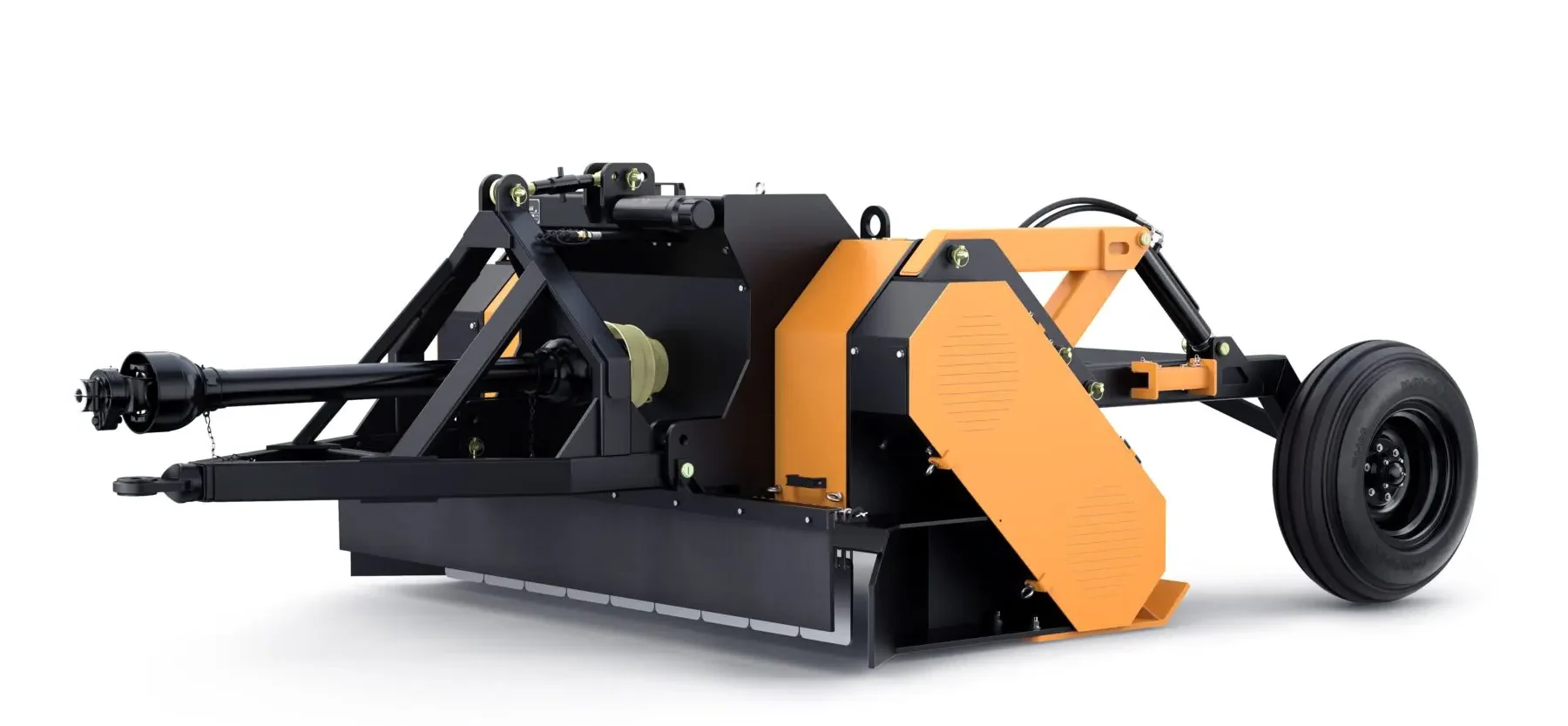
Understanding the main components helps you compare models and assess long-term operating costs before buying:
The central working element. A larger rotor diameter means more kinetic energy and the ability to process larger stones. Rotor size is the primary differentiator between light-duty (450mm), mid-range (550mm), and heavy-duty (700mm) machines.
Hardened steel teeth are the primary wear components, designed to be replaced individually without removing the rotor. Tooth count varies by working width — more teeth give a finer finish and lower per-tooth load during operation.
Fixed inside the housing, these provide the opposing surface against which stones are shattered. Their geometry determines how efficiently stones are broken down before being discharged from the rear of the machine.
Connects the tractor to the machine. ST variants accept both 540rpm and 1000rpm PTO outputs for broad tractor compatibility. DT and HP variants require 1000rpm. Always confirm PTO speed compatibility before ordering.
Category 2 rear linkage is standard on most models, compatible with tractors from 70hp upward. Confirm your tractor’s linkage category and rear lift capacity against the machine weight before purchase.
Follows the rotor and consolidates the treated surface after each pass, leaving a level finish and helping regulate working depth across uneven terrain.
What Stones Can a Tractor Stone Crusher Process?
The maximum shredding diameter — the largest stone a machine can reliably process — varies significantly across the range and is directly related to rotor size and tractor power:
| SPECIFICATION | Light-duty | Mid-range | Heavy-duty |
|---|---|---|---|
| Performance & Power | |||
| Tractor power (hp) | 70 – 150 | 80 – 280 | 280 – 400 |
| Rotor diameter (mm) | 450 | 550 | 700 |
| Max shredding diameter (mm) | 150 | 300 | 500 |
| Max working depth (mm) | 150 | 200 | 250 |
| Working widths (mm) | 1,110–2,070 | 1,340–2,304 | 2,080–2,560 |
| Best For | |||
| Typical application | Vineyards, orchards, arable farms | Large arable, road prep, contracting | Civil works, heavy contracting, land reclamation |
For most European arable and vineyard applications, stones up to 150mm are the norm — the light-duty series is the right starting point. Where larger embedded rocks are common (post-glacial soils, former quarry land, or road construction), step up to mid-range or heavy-duty. Contact our team with your soil type and stone conditions — we’ll recommend the right series.
Stone Crusher vs Mulcher: What Is the Difference?
This is one of the most common points of confusion when buying field preparation machinery. Both are rotor-driven PTO implements that attach to a tractor’s rear linkage — but they are engineered for completely different tasks and are not interchangeable.
- Designed for stone and rock impact duty
- Reinforced rotor with hardened stone-rated teeth
- Heavy armoured housing rated for impact loads
- Significantly heavier machine construction
- Pulverises stones and returns material to soil
- Works to 150–250mm depth in a single pass
- Designed for vegetation, crop residues, branches
- Lighter rotor optimised for cutting plant matter
- Teeth NOT rated for stone impact
- Lighter overall construction
- Will sustain rapid damage on stony ground
- Warranty void if used on stone
If your land has stones — even occasional surface stones — always specify a stone crusher. A mulcher is not a substitute and should never be operated on stony ground. Doing so causes rapid tooth wear, rotor damage, and in some cases catastrophic failure when a large stone is struck at operating speed.
Where Are Tractor Stone Crushers Used?
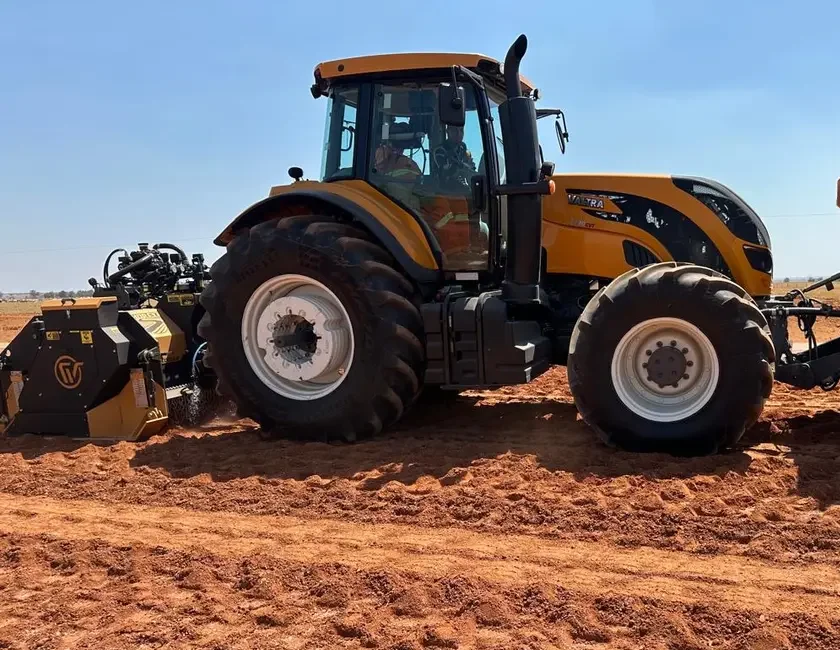
Tractor stone crushers are used across a wide range of agricultural and civil applications throughout Europe. The five most common use cases are:
Removing surface and sub-surface stones before drilling or planting reduces seed drill wear, improves seed placement accuracy, and prevents harvest header damage. A single stone crusher pass can eliminate two or three additional soil preparation operations ahead of drilling.
Compact light-duty models with working widths from 1,110mm suit the narrow row spacings of European vineyards and orchards. Stone removal improves mechanical harvester performance and reduces tyre damage during picking seasons without disturbing root systems.
Stone crushers consolidate loose surface stones into the track base, improving all-weather load-bearing capacity for harvest machinery and livestock vehicles — without the cost of importing crushed aggregate.
Mid-range and heavy-duty machines are used in civil contracting to break up compacted stone layers before road construction — reducing the need for mechanical breaking and aggregate removal, producing a consolidated sub-base surface ready for road formation.
Heavy-duty models can process stones up to 500mm in diameter, making them suitable for forestry clearance, derelict site preparation, and large-scale land reclamation projects where stone density and size exceed what lighter machines can handle.
الأسئلة الشائعة
A tractor stone crusher is a PTO-driven implement attached to the rear three-point linkage of a tractor. It uses a high-speed rotating rotor fitted with hardened teeth to pulverise stones in the soil, returning the crushed material directly to the ground in a single pass — eliminating the need for stone collection or removal.
Working depth varies by series: light-duty models reach 150mm, mid-range models 200mm, and heavy-duty models 250mm. Actual depth is also affected by tractor forward speed and ground hardness — slower passes allow deeper penetration in compact or clay-heavy soils.
A stone crusher is engineered specifically for stone impact duty — reinforced rotor, hardened stone-rated teeth, heavy armoured housing. A mulcher is designed for organic material (crop residues, vegetation, branches) and is not rated for stone contact. Using a mulcher on stony ground causes rapid rotor damage and voids the warranty.
Light-duty stone crushers start at 70hp (compatible up to 150hp). Mid-range machines cover 80–280hp, and heavy-duty models require 280–400hp. The right match also depends on PTO speed (540rpm or 1000rpm), rear linkage category, and rear axle load capacity. Contact our team to confirm compatibility with your specific tractor model.
Ready to Find the Right Stone Crusher for Your Tractor?
We supply tractor stone crushers for 70hp to 400hp tractors — CE certified, permanently stocked in the Netherlands, with genuine spare parts available within 48–72 hours. Contact our team for a personalised recommendation and Europe-wide delivery quotation.