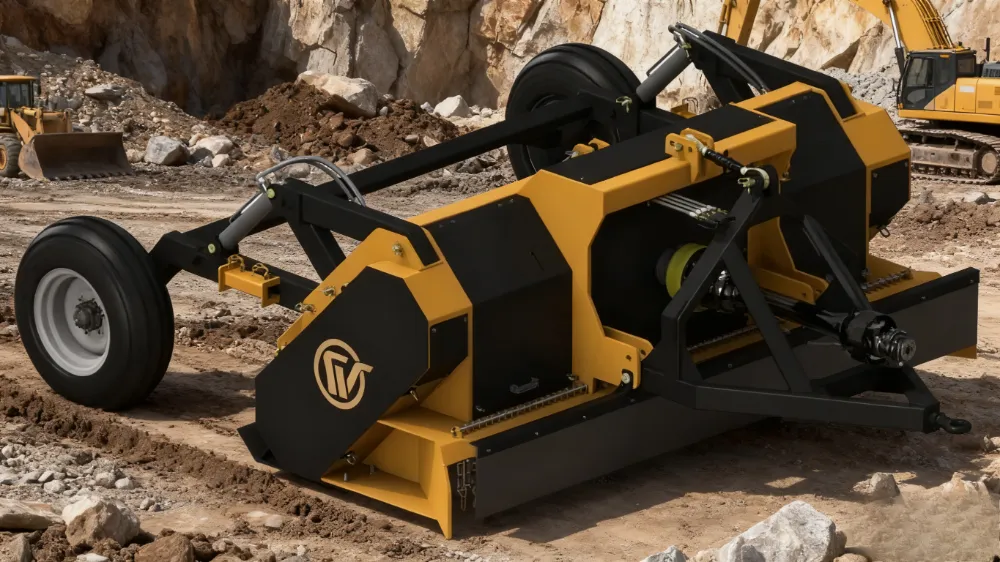
When stones are causing problems on your land, two machines are commonly recommended: a stone crusher and a rock picker. Both deal with stones. Both attach to a tractor. But they work in completely different ways and solve completely different problems — and buying the wrong one first can cost you significant time and money before you realise the mistake.
This guide explains exactly what each machine does, compares them side by side, and helps you decide which one to buy first — or whether you eventually need both.
What a stone crusher does
What a rock picker does
Side-by-side comparison
When to choose each
Can you use both?
Συχνές ερωτήσεις
The Core Difference — One Word
The entire difference between these two machines comes down to one word: destination.
Stones stay in the field. They are pulverised in place and returned to the soil. Nothing is removed.
Stones are collected from the surface and transported away from the field. Material is physically removed.
This single distinction drives every other difference between them — what they can handle, how they work, which tractor power they need, and what they cost to operate. Understanding it is the key to making the right choice for your land.
What Does a Stone Crusher Do?
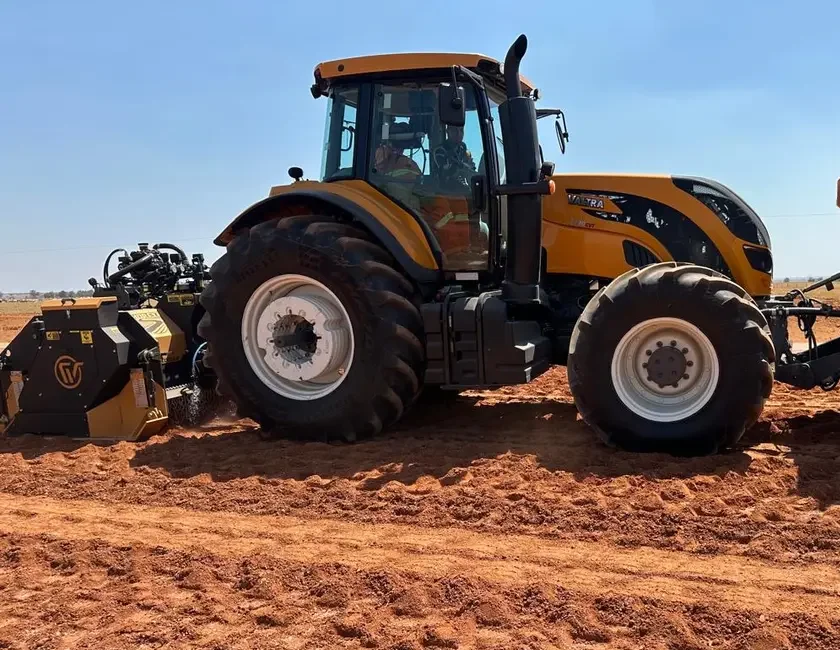
A tractor stone crusher is a PTO-driven implement that uses a high-speed rotor fitted with hardened teeth to pulverise stones embedded in the soil. As the machine moves forward, the rotor penetrates the soil surface, strikes stones with high-force impact, and fractures them into small fragments that are redistributed evenly across the treated area — all in a single pass.
The key operational characteristic is that the crushed material stays in the field. Stones are not collected, loaded, or transported — they are broken down until they are no longer a problem and incorporated back into the soil profile. This approach is permanent: once a stone has been crushed to sub-surface particle size, it will not resurface or cause further equipment damage in the treated area.
Stone crushers are available in light-duty (70–150hp, max 150mm stone), mid-range (80–280hp, max 300mm stone), and heavy-duty (280–400hp, max 500mm stone) configurations. For a detailed overview of stone crusher types and how they are categorised, see this οδηγός αναφοράς για θραυστήρα πέτρας.
What Does a Rock Picker Do?
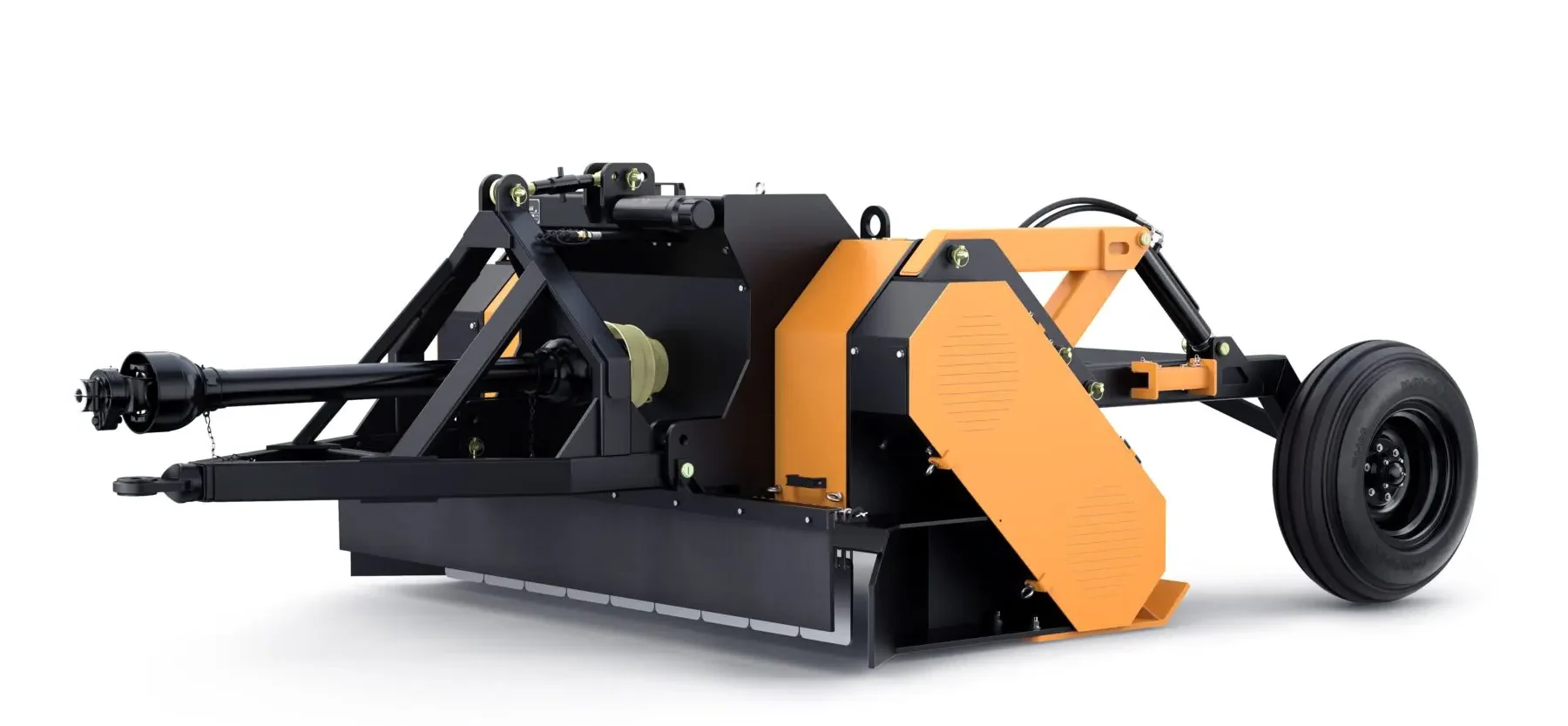
A rock picker — also called a stone picker or rock collector — is a hydraulically driven implement that moves across the field surface, scooping up stones and depositing them into an onboard collection bunker. Once the bunker is full, the operator drives to the field edge, empties it, and continues.
Unlike a stone crusher, a rock picker operates on the soil surface only — it does not penetrate to any significant depth. It is designed to collect stones that are already visible on or just below the surface, typically after cultivation has brought them up. It physically removes those stones from the field, which is useful where stones need to be cleared completely — for example, ahead of potato planting or mechanical harvesting operations where any surface stone can jam or damage equipment.
The CT-2100 rock picker from Watanabe Netherlands has a working width of 1,950mm, a bunker capacity of 2.5m³, and requires a minimum of 110hp with a 60 L/min hydraulic oil flow. Working speed is 3–5 km/h.
Side-by-Side Comparison
Here is how the two machines compare across the factors that matter most to a European farmer or contractor:
| FACTOR | Θραυστήρας πέτρας | Συλλέκτης βράχων |
|---|---|---|
| How It Works | ||
| Stone destination | Pulverised in place, stays in field | Collected and physically removed |
| Working depth | 150–250mm (sub-surface) | Surface only |
| Stone size handled | Up to 500mm diameter | Surface stones — varies by model |
| Result | Permanent — stones cannot resurface | Temporary — new stones emerge after cultivation |
| Απαιτήσεις τρακτέρ | ||
| Minimum tractor power | From 70hp | From 110hp (CT-2100) |
| PTO required | Yes — 540 or 1000rpm | Hydraulic — 60 L/min oil flow |
| Linkage | Rear 3-point, Category 2 | Rear 3-point, Category 2 |
| Operation | ||
| Passes required | Single pass — complete in one go | Multiple passes + bunker emptying cycles |
| Stone disposal required | No | Yes — stones must be removed from field |
| Works on uncultivated ground | Yes | Less effective — stones must be at surface |
| Best Application | ||
| Arable land preparation | ✓ Excellent — permanent result | ✓ Good for post-cultivation surface clearance |
| Vineyard / orchard | ✓ Excellent — compact models available | Limited — row spacing constraints |
| Potato field preparation | ✓ Good pre-season treatment | ✓ Excellent post-cultivation clearance |
| Road / civil works | ✓ Excellent | Not suitable |
| Where stones must be removed | Not applicable | ✓ Only option |
When to Choose a Stone Crusher
A stone crusher is the right choice in these situations:
Once a stone crusher has treated a field, the stones in that area are permanently eliminated. They cannot resurface after cultivation because they no longer exist as solid objects. A rock picker removes surface stones but leaves sub-surface stones intact — they reappear after every ploughing cycle.
A rock picker only works on stones at or just below the soil surface. Sub-surface stones — which are the cause of most seed drill and tillage equipment damage — can only be addressed by a stone crusher, which works to depths of 150–250mm depending on the series.
Road sub-base preparation, site clearance, and rural infrastructure works require the crushing capacity and working depth that only a mid-range or heavy-duty stone crusher can deliver. A rock picker has no application in civil groundworks.
Compact stone crusher models starting at 1,110mm working width fit within standard European vine row spacings. A rock picker’s geometry and working width make it unsuitable for most vineyard and orchard applications where row spacing constrains machine dimensions.
When to Choose a Rock Picker
A rock picker is the right choice in these specific situations:
Potato growers in particular require fields that are as stone-free as possible before planting and harvesting. Even small stones that remain in the soil after crushing can damage potato diggers and contaminate harvested crop. In this case, stone removal — not pulverisation — is the objective.
Deep autumn ploughing regularly brings previously buried stones to the surface. A rock picker run across the field after ploughing and before spring cultivation clears these surface stones quickly and efficiently ahead of drilling.
Boulders and surface rocks significantly above 500mm in diameter — beyond the rated capacity of even the heaviest stone crushers — need to be physically picked up and removed. In this situation a rock picker (or excavator and trailer) is the only option.
Can You Use Both Together?
Yes — and for operations with particularly heavy stone burdens, using both machines in sequence is the most effective approach. The typical combined workflow for arable land with a significant stone problem looks like this:
For most arable operations in the Netherlands, UK, Belgium, and France, a stone crusher alone is sufficient for long-term field management. The combined approach is most commonly used by potato specialists and market vegetable growers where zero stone tolerance is required at harvest. If you are unsure which applies to your operation, contact our team for advice.
Συχνές ερωτήσεις
For most mixed arable operations, a stone crusher delivers better long-term value. It permanently eliminates sub-surface stones — the primary source of seed drill, plough, and harvest header damage — in a single pass, with no disposal requirement. A rock picker removes surface stones only and requires repeated passes as cultivation brings new stones up each season. Unless stones must be physically removed from the field (potato growing, market vegetables), a stone crusher should be the first purchase.
Yes. A stone crusher processes both surface and sub-surface stones simultaneously in a single pass. It does not need stones to be at any particular depth to operate effectively — surface stones are picked up by the rotor teeth on the first contact and processed along with embedded material.
Yes, and this is the recommended sequence for the highest stone clearance standard. After the stone crusher has processed the bulk of the stone burden to depth, a cultivation pass brings any remaining small fragments to the surface. A rock picker then collects these surface fragments for complete removal. This combined approach is standard practice for potato growing in high-stone-burden areas of Europe.
Yes. Watanabe Netherlands supplies both tractor stone crushers across the full 70–400hp range and the CT-2100 rock picker. Contact our team at [email protected] to discuss your specific requirements — we can advise on the right combination and provide a combined delivery quotation to your location across Europe.
Not Sure Which Machine You Need?
Tell us your tractor specification, field conditions, and what crops you grow — our team will advise whether a stone crusher, rock picker, or both is the right solution, and provide a delivery quotation across Europe.