
Sourcing a tractor stone crusher in Europe involves more than comparing specifications and prices. The supplier location, stock position, CE certification status, parts availability, and after-sales support structure all determine whether a machine that looks good on paper actually delivers reliable performance over a working season. For European buyers — particularly those in the Netherlands, Belgium, Germany, and France — these factors matter differently than they do for buyers sourcing directly from overseas. This guide explains what to verify before purchasing, why CE certification is non-negotiable on European public contracts, how Netherlands stock changes the delivery and support equation, and what the purchasing process with Watanabe Netherlands actually involves.
Why Supplier Location Matters More Than You Think
Most European buyers searching for a tractor stone crusher will encounter suppliers operating from three different positions in the supply chain: European-based distributors holding local stock, European agents importing on order from manufacturers in Brazil, Italy, Austria, or China, and direct overseas suppliers requiring buyers to handle import clearance themselves. Each model produces a different buying experience, and the differences are most visible not at the point of purchase but six months later when a tooth set needs replacing or a warranty issue arises.
EU Stock Supplier
Machine physically held in Europe. CE preparation and testing done locally. Delivery 7–14 days. Warranty handled in-country. Wear parts available from same stock within 48–72 hours.
Best for: Buyers who need certainty on delivery, CE documentation, and ongoing parts support.
European Agent (Order Import)
No local stock. Machine ordered on purchase, imported from manufacturer country. Lead time 8–20 weeks. CE documentation may be available. Parts ordered case by case from overseas.
Best for: Buyers with flexible timelines and specific model requirements not held in stock.
Direct Overseas Supplier
Machine shipped from manufacturer country. Buyer handles import clearance, VAT, and CE compliance independently. Lead time 10–20 weeks. Parts lead time 4–8 weeks. Technical support in manufacturer timezone.
Best for: Buyers with import experience and tolerance for long lead times on parts.
CE Certification: What It Means and Why It Is Non-Negotiable
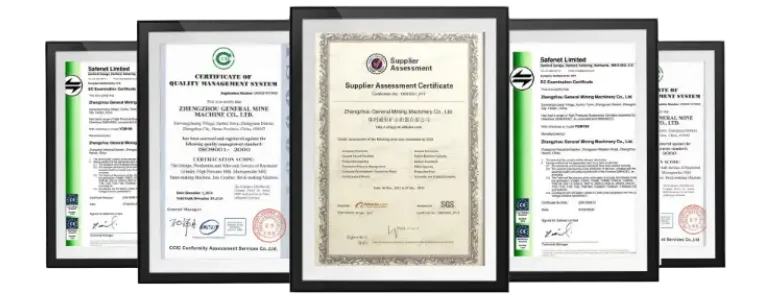
CE marking on a tractor stone crusher is not a quality badge — it is a legal declaration that the machine meets the essential health and safety requirements of the applicable EU Directives, specifically the Machinery Directive 2006/42/EC and the relevant harmonised EN standards. In the European Economic Area, placing a machine on the market or putting it into service without the required CE marking is a criminal offence for the supplier. Buying and operating a non-CE machine is a liability for the buyer.
What CE Certification Requires for a Stone Crusher
Technical file demonstrating conformity with EN ISO 4254-7 (agricultural machinery safety) and EN 13525 (forest machines — stone crushing machines)
Risk assessment conducted under the Machinery Directive and documented in the technical file
Declaration of Conformity signed by the responsible EU-based legal entity
Operator manual in the language(s) of the country of use
Safety guards, emergency stop systems, and warning labels meeting the requirements specified in the harmonised standards
Physical CE marking plate affixed to the machine with the year of manufacture
In practical terms, CE certification matters to European buyers in three specific contexts:
Public Contracts
Municipal road contracts, government-funded rural infrastructure schemes, and forestry management contracts in the EU almost universally require CE-marked machinery as a condition of the tender specification. A machine without valid CE documentation cannot legally be used on these projects, regardless of its actual specification.
Insurance
Agricultural and construction liability insurance policies in the Netherlands, Belgium, and Germany routinely require CE documentation for tractor-mounted powered implements. Operating a non-CE machine invalidates the liability cover for incidents involving that machine — exposing the operator to personal liability for any injury or third-party damage.
Wiederverkaufswert
A used stone crusher without CE documentation has a significantly reduced secondary market value in Europe — professional buyers understand the liability position and price accordingly. CE-documented machines from reputable European suppliers hold their value substantially better than equivalent specification machines without documentation.
Netherlands Stock: What It Actually Changes for the Buyer
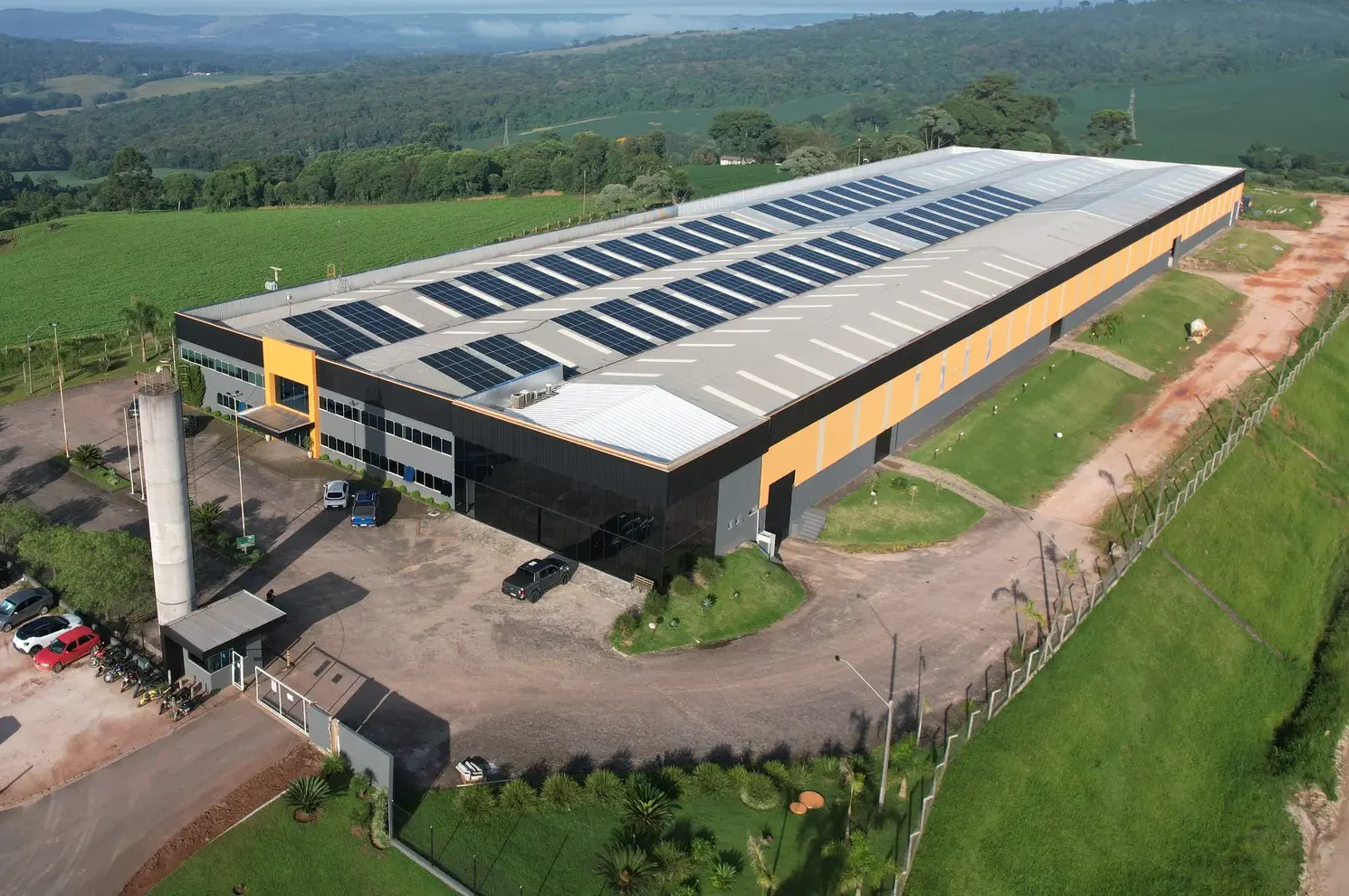
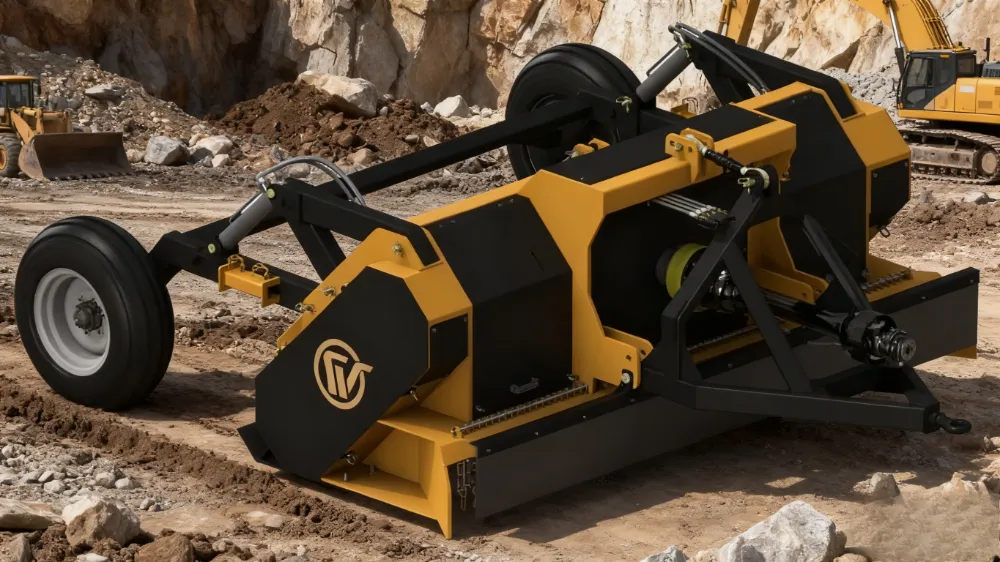
Watanabe Netherlands maintains permanent stock of the full THOR stone crusher range at its warehouse in Doetinchem, Netherlands. This means the machine exists physically in the EU before a buyer places an order — it does not need to be manufactured, shipped from Brazil, cleared through customs, or registered in Europe. The practical consequences of this for buyers are significant:
Delivery 7–14 Days Across the EU
Standard configurations are available for delivery to the Netherlands, Belgium, Germany, and France within 7–14 days of order. Benelux deliveries are often possible within 5–7 days. There is no waiting for international shipping, customs clearance, or port handling — the machine ships from a Dutch address on a standard flatbed trailer.
Pre-Delivery Inspection and CE Preparation
Every machine is inspected, prepared, and CE documentation issued at the Doetinchem facility before delivery. The buyer receives the machine fully assembled, tested, and accompanied by a complete documentation package including Declaration of Conformity, operator manual in Dutch/English/German, and CE marking certificate.
In-Person Machine Inspection Before Purchase
Buyers within driving distance of Doetinchem — which includes most of the Netherlands, Belgium, and the German Ruhr region — can visit the facility to inspect machines before ordering. Watanabe Netherlands also arranges on-farm demonstrations across the Benelux and western Germany for buyers who want to see the THOR series operating in their specific soil conditions before committing.
Warranty Handled Locally — No International Shipping
Warranty claims are handled directly by the Watanabe Netherlands team in Doetinchem. There is no requirement to ship the machine back to Brazil or communicate with a manufacturer in a different time zone. The warranty process involves contacting the Netherlands office, which evaluates and resolves claims locally — typically within one working week for standard issues.
Spare Parts: The Specification That Determines Long-Term Running Cost
The cost of the machine is a one-time purchase decision. The cost of running it — carbide teeth, belt sets, bearings, tooth holders, hydraulic seals — is a recurring cost that accumulates across every working season. The parts supply structure of the supplier you choose determines both the price of those consumables and the lead time when you need them during the working season.
| Wear Part | Watanabe Netherlands Lead Time | Overseas Direct Lead Time | Season Impact of Delay |
|---|---|---|---|
| Carbide tooth set | 48–72 hours | 4–8 weeks | Machine stops work — season window lost |
| Drive belt set | 48–72 hours | 4–8 weeks | Machine stops work — 2–4 day stoppage minimum |
| Rotor bearing | 48–72 hours | 6–10 weeks | Machine stops — extended downtime, secondary damage risk |
| Hydraulic seal kit | 48–72 hours | 4–8 weeks | Hydraulic leak — safety issue on public contracts |
| Tooth holder | 48–72 hours | 6–12 weeks | Rotor imbalance — machine cannot operate safely |
The difference between 48–72 hours and 4–8 weeks for a carbide tooth set is the difference between a one-day interruption during which you prepare the new set and a full month of machine downtime at the peak of the working season. For a contractor billing machine hours, the lost revenue from a four-week stoppage in the spring land preparation window can equal or exceed the price difference between a Netherlands-stocked machine and a lower-priced overseas-sourced alternative.
The THOR Range: Which Configuration to Specify
Watanabe Netherlands supplies the full tractor stone crusher range from Netherlands stock, covering the complete horsepower spectrum from 70 hp to 400 hp. The THOR series represents the hydraulically driven flagship range — the most commonly specified configuration for European professional applications.
THOR 2.4 AR
The European Standard
Working width: 2.4 m · Min. power: 180 hp · Weight: 2,300 kg · Category 2 linkage · Hydraulic drive · CE certified.
The most widely deployed stone crusher in European agriculture and light construction. Compatible with Fendt 700, John Deere 6R, Claas Arion, New Holland T7, Valtra T series and equivalents. Suitable for arable land preparation, vineyard and orchard work, farm road construction, and light forestry site reclamation.
THOR 3.0 AR
The Contractor Standard
Working width: 3.0 m · Min. power: 230 hp · Weight: 2,800 kg · Category 2 linkage · Hydraulic drive · CE certified.
Chosen by contractors running large farm operations, road construction projects, and forestry reclamation work where daily area coverage determines project economics. Compatible with Fendt 900/1000, John Deere 7R/8R, Claas Axion, Case IH Puma/Optum and equivalents. Processes the same stone sizes as the 2.4 AR with 25% higher working width for faster site coverage.
Beyond the THOR series, the STCL, STCM, and STCH ranges extend coverage from 70 hp vineyard machines to 400 hp infrastructure equipment. Specifications for each configuration, including tractor compatibility matrices, are detailed on the THOR 2.4 AR product page and the associated range pages. Buyers working across multiple applications — stone crushing, soil stabilization, and agricultural ground preparation — should also note that Watanabe Netherlands supplies the complete equipment sequence, including rock rakes, rock pickers, and rotavetors, from the same Netherlands base. For the broader European agricultural machinery supply chain context, SSJ Group provides a range of flail mower and agricultural gearbox components supplying the European market under CE and ISO certification — a reference point for buyers evaluating certification standards across the agricultural machinery sector.
The Purchasing Process: What to Expect
Initial Enquiry and Specification
Contact the Watanabe Netherlands team with your tractor model and horsepower, your typical stone size range, working depth requirement, and primary application — agricultural, construction, or forestry. The team returns a machine recommendation and written quotation within 24 hours, including transport cost to your delivery address.
Demonstration or Inspection (Optional)
Buyers within the Benelux and western Germany can arrange a visit to the Doetinchem facility to inspect the machine in person, or request an on-farm demonstration at their location. Demonstrations are arranged for buyers who want to see the machine operating in their specific soil conditions before placing an order.
Order and CE Preparation
On order, the machine is assigned from Netherlands stock, inspected, CE documentation issued, and prepared for delivery. Standard configurations are typically ready within 3–5 working days of order confirmation. Custom configurations or non-standard options may require 2–4 additional weeks.
Delivery and Commissioning
The machine is delivered fully assembled on a flatbed to your address. On-site commissioning and operator training are available on request — particularly recommended for operators new to hydraulically driven stone crushers or for large teams working a new machine type for the first time.
Ongoing Support and Parts
After delivery, the Watanabe Netherlands team provides technical support in Dutch, English, German, and French for the operational life of the machine. Genuine wear parts are held in stock and shipped within 48–72 hours on request. Annual service reminders and wear part consumption guidance are available for buyers who want a structured maintenance relationship rather than reactive parts ordering.
Ready to Get a Quote?
Send us your tractor model, horsepower, and a brief description of your application — we return a machine recommendation and delivered price within 24 hours. Demonstrations available across the Netherlands, Belgium, and western Germany.


